 ben's notes
Planetary Systems
Models of the Solar System #
What is prograde and retrograde motion?
- Strangely, planets seem to occasionally move backwards. In Ptolemy’s geocentric theory, retrograde motion could be explained by other planets (which are orbiting Earth) are also moving in a circular motion relative to the center of their orbit around Earth, in what is known as an epicycle:
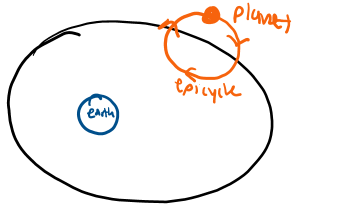
- In Copernicus’ heliocentric model (which is used today), all planets including Earth all orbit the Sun. Since Earth and the other planets orbit the Sun at different rates, retrograde motion occurs when the Earth passes the other planets in their relative orbits.
- A planet can be observed to be in prograde motion if, over time, its position changes in the same direction as the rest of the stars in the sky. On the other hand, if the planet’s position changes in the opposite direction as the stars, then it must be in retrograde motion.
- Prograde and retrograde motion can only be observed after many individual observations over several weeks or months.
How was Ptolemy’s model disproved?
- Venus could be observed to go through a complete set of phases (including gibbous phases). This refutes the Ptolemaic model: if Venus really were between the Earth and Sun, then it could only be observed to have crescent phases.
- When Venus was observed in a crescent phase, it appeared significantly larger than when it was in a gibbous phase. This would not be possible to such an extent in the Ptolemaic model since the radius of the epicycle is far smaller than the radius of Venus’s orbit around Earth.
What were some of Galileo’s discoveries?
- Jupiter has 4 moons (demonstrates that Earth is not unique in that it has a moon)
- The moon has craters (demonstrates that the Moon is not a perfect creation)
- The time it takes objects to fall under influence of gravity is the same regardless of mass.
Kepler’s Laws #
What are Kepler’s Laws of planetary motion?
First law: Planetary orbits are ellipses with the Sun at one focus.
Second law: A line between the Sun and a planet sweeps out equal areas in equal times.
When the planet is closer to the Sun, it must therefore move more quickly, since the area of the ellipse closer to the Sun is smaller.
Third law: The square of a planet’s orbital period is proportional to the cube of its semimajor axis (the distance between the center of the ellipse and the furthest point from the center on the ellipse):
$$ P^2 = kR^3 $$- Kepler’s Third Law is not exactly correct. A more accurate equation would be:
- The force of gravity depends on the mass of the planet and the star it’s orbiting.
Planets of the Solar System #
Why can Venus never be seen high in the sky at midnight?
- Venus orbits more closely to the sun than the Earth does. At midnight, the sun is on the opposite side of the Earth, so if Venus were high in the sky, it would suggest that it were actually orbiting farther away from the sun (i.e. the Earth were between the sun and Venus). Since this is inaccurate, we never see Venus high in the sky at midnight.
What is the greenhouse effect?
- The greenhouse effect occurs when visible light can enter the atmosphere, but infrared cannot enter or escape. When visible light hits the surface, some of it is converted to infrared, which heats up the planet.
- Venus is an example of a planet that has a runaway greenhouse effect (very hot due to thick atmosphere trapping in heat)
Why is Mars such a good candidate to search for life?
- There is evidence in geological formations that water used to be abundant on Mars (valleys, river beds, flood plains…)
- Mars likely used to have a thick atmosphere in its early existence in order to support liquid water and the formation of current features.
- Some water is still frozen in polar icecaps and permafrost, meaning that we may be able to find evidence for life locked within them.
Why are planets further away from the sun so much larger?
- Planets further away from the Sun, like Jupiter and Saturn, can attract snow/ice and gas which would have been melted or blown away from the inner disk of planets closer to the Sun. Thus, we should expect their size to be larger than the rocky planets since they are surrounded by materials of lower density that wouldn’t have been attracted closer to the sun.
How did Saturn’s rings form?
- Saturn’s rings are close enough to the planet such that they are within its Roche limit: the maximum distance in which the tidal forces of the planet overcome the force of gravity holding objects together.
- The Roche limit explains why the rings did not combine into a moon: it would be impossible for such a moon to form so close to Saturn, because it would just be torn apart by the tidal forces.
Why is Pluto not considered a planet?
- After the discovery of many similar Kuiper belt objects (collection of icy asteroids, comets, and other objects that exist beyond the orbit of Neptune), Pluto was demoted to a dwarf planet.
- If Pluto were considered a planet, we would also consider 50+ other objects as planets.
- In order to formally be considered a planet, an object must:
- primarily orbit the sun (i.e. not a moon)
- be massive enough to be roughly spherical due to its own gravity (>600 km diameter)
- have cleared most other objects other than moons or rings out of its neighborhood
Comets, Meteors, and Asteroids #
What are comets?
- Comets are balls of ice and dirt that sublimate as they approach the sun.
- A comet’s tail is created by ice, dust, and gases pushed away from the comet by radiation and solar wind coming from the Sun. The glow from a comet’s tail is from the ions in the gases emitting visible light radiation from the Sun.
- Comet’s tails point away from the sun since solar radiation pressure acts away from the sun.
- Due to Kepler’s 2nd Law, comets that have highly eccentric orbits spend most of their time far away from the sun.
What are meteors?
- A meteor (“shooting star”) is the quick streak of light in the sky produced when a small rock or chunk of ice zips through Earth’s atmosphere and burns up owing to friction with the air. Most of them are tiny, the size of a pebble or a grain of sand.
- Meteor showers typically occur when the Earth passes through the orbit of a disintegrated comet. Without the influence of other objects, the pieces of the comet will still be roughly following the same orbit, and will collide with the Earth at around the same time.
Why does the asteroid belt exist instead of another planet in between Mars and Jupiter?
- The asteroid belt consists of rocks that were prevented from coming together and forming a planet because of Jupiter’s gravitational influence. Jupiter caused the orbits of the rocks to be elliptical, which meant that they collided with each other at higher speeds than in circular orbits, leading to shattering instead of coalescing into a planet.
Exoplanets #
What are exoplanets?
- Exoplanets are planets found orbiting stars other than the Sun.
- They are typically very difficult to find because stars are much brighter and larger than them.
How are exoplanets discovered?
- Doppler wobble: When a star is pulled away from the Earth by a planet, the wavelength of the light arriving to the Earth from the star will be red-shifted (i.e. longer). Conversely, when a star is pulled towards the Earth, the light will become blue-shifted.
- This method only gives the minimum mass of the planet, because it assumes the inclination of the orbit with respect to the Earth is exactly zero.
- Exoplanet transit: If a planet passes in between a star and the Earth, then the brightness of the star as observed on Earth will decrease slightly as it blocks the star in its orbit.
- Transit can only be observed if the exoplanet is orbiting in almost the same plane as the Earth (exactly on our line of sight).
How can we measure the density of exoplanets?
- Since density is mass/volume, we need to get both the mass and volume of the exoplanet to calculate it. Through the Doppler wobble method, we can get the mass by calculating the relative shift in wavelength caused by the planet’s gravitational pull. To get the volume, we need to get the radius of the planet as measured by observing it in transit (can derive by comparing the cross-sectional area of the planet relative to the star), and multiply it by 4/3 π r^3. Due to the fact that the planet is transiting, this method gives the actual mass of the planet (since the planet’s inclination must be near zero).