 ben's notes
The Sun, Moon and Earth
The Moon #
How do you predict where the moon will be in the sky?
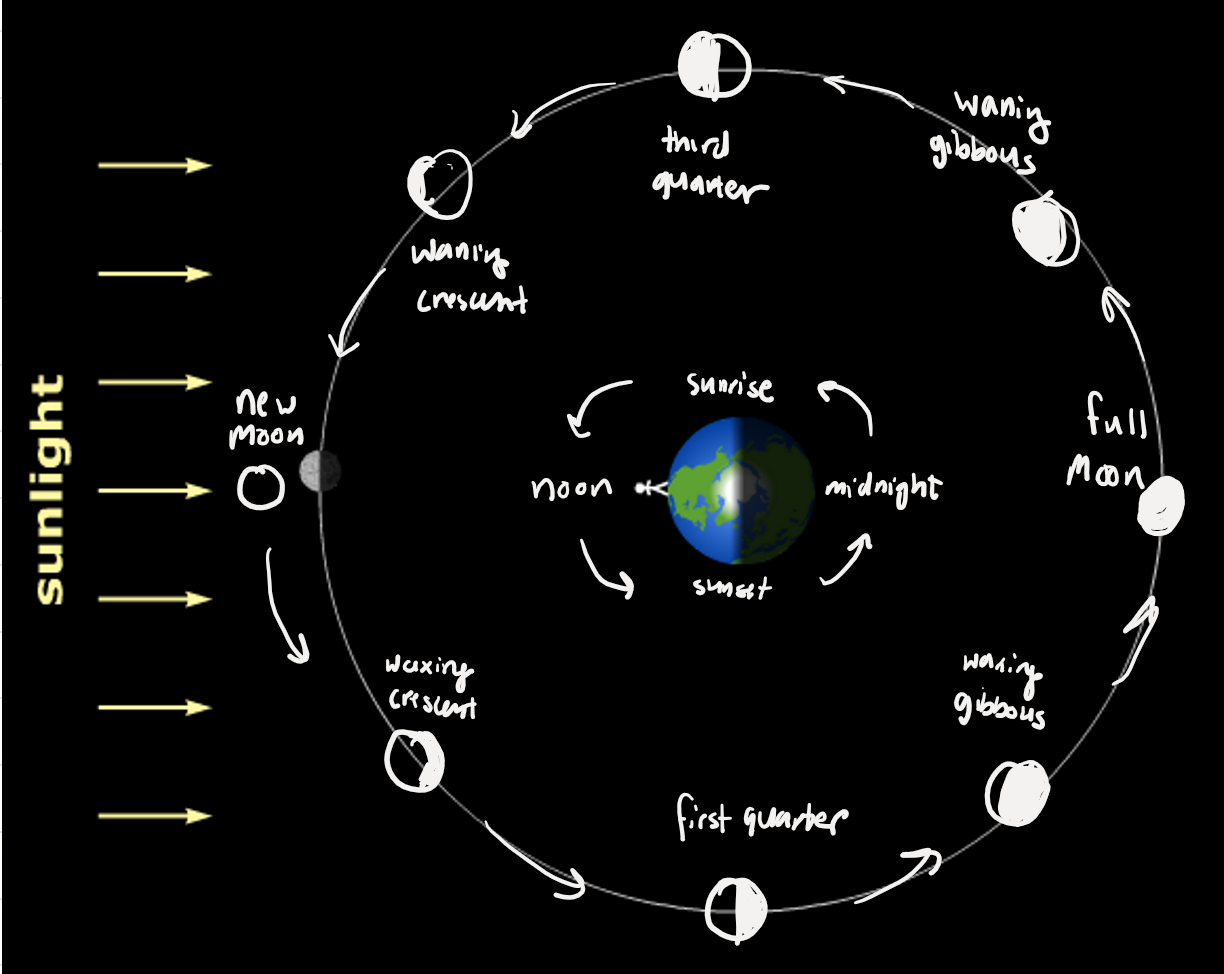
What phase would an astronaut on the surface of the moon see the Earth as?
- The opposite phase of the moon on Earth- for example, if observers on Earth saw a waning gibbous, the Earth would be seen as a waxing crescent from the moon.
What is earthshine?
- Earthshine is sunlight that was first reflected from Earth, then from the moon back to Earth. It is most visible during the crescent phase.
How old is the Moon?
- The moon is about 4.6 billion years old. We have determined this by comparing the absolute and relative ages of rocks from the moon: via radioactive dating, we know that the intense early bombardment of the moon’s surface occurred shortly after the formation of the moon and solar system.
Earth #
How do solar eclipses work?
How do seasons work?
- The primary explanation for the seasons is not the change in distance, but rather the tilt of the Earth. The side of the Earth that is facing the sun receives more sunlight for a greater amount of the day, thus experiencing summer; the other side is facing away from the sun, so it receives less sunlight and experiences winter.
How do tides work?
- Tides happen because of the differential pull of the Moon on Earth i.e., the difference in the pull of the Moon’s gravity on different locations of Earth. (The differential pull of the Sun on Earth also helps produce tides, but it is a secondary cause; the Moon is dominant.)
- By Newton’s law of universal gravitation, the gravitational force is stronger for smaller distances than for larger distances. Thus, the Moon pulls most strongly on the side of Earth nearest to it, less strongly on the center of Earth, and even less strongly on the side of Earth farthest from it. This means that the water is pulled away from Earth on the side nearest the Moon; on the far side, Earth is pulled away from the water. Compared to the center of Earth, the near side is pulled toward the Moon, and the far side is pulled away from the Moon; thus, there are two regions of high tide.
The Sun #
What are the different parts of the Sun?
- The photosphere is the visible “surface” of the sun. It appears solid because the gas that it’s composed of gets dense enough that it becomes opaque.
- The chromosphere is a thin, pinkish-red layer around the Sun that is hotter than the photosphere.
- The corona is a large, low-density envelope surrounding the Sun that is held up by magnetic fields.
- The sun’s core is the hottest part at the center.
What are some solar phenomena that we can observe?
- The Solar activity cycle repeats every 11 years or so, causing the following:
- A change in the number of sunspots, from nearly zero to several hundred;
- A change in the frequency of solar flares and prominences, in which material from the sun reaches out further than its typical radius;
- A change in the frequency of coronal mass ejections, in which material from the sun is sent outwards.
- Solar wind (electrons and positive ions from the sun) interact with comets to create their tails, and planetary magnetic fields to produce auroras.
- Solar flares are violent releases of energy from the sun (similar to coronal mass ejections, which are even larger).
- Prominences are loops of gas above the chromosphere.
- Sunspots are regions of strong magnetic fields that inhibit the rise of hot gas from below.