 ben's notes
Thermal Emitters
Stars are huge, opaque, luminous balls of gas held together by gravity.
The inner parts of a star are so hot that they continuously emit radiation of all wavelengths, which is known as a continuum.
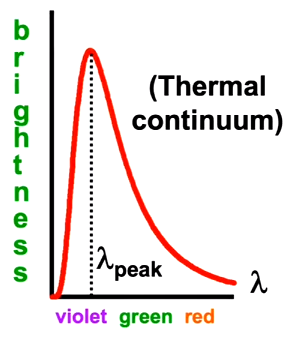
The shape of a thermal continuum is known as a Planck curve.
Stars are usually so hot that there are only slight imperfections in the continuum. Therefore, for many approximate calculations, we can pretend that they are perfect thermal emitters, otherwise known as blackbodies.
The Colors of Stars #
If stars emit white light, then why do some stars appear red or yellow or blue?
Although the inside of the star constantly emits radiation, the outer parts of the star, which are essentially a giant cloud of gas, are cool enough that they absorb some wavelengths.
Additionally, depending on how hot the star is, the shape of the continuum (and the brightest wavelength at the peak) changes: the hotter the object, the shorter the wavelength. This ties into the whole energy thing: hotter = more energy, and shorter wavelength/higher frequency = more energy, so it makes sense for the two to be correlated.
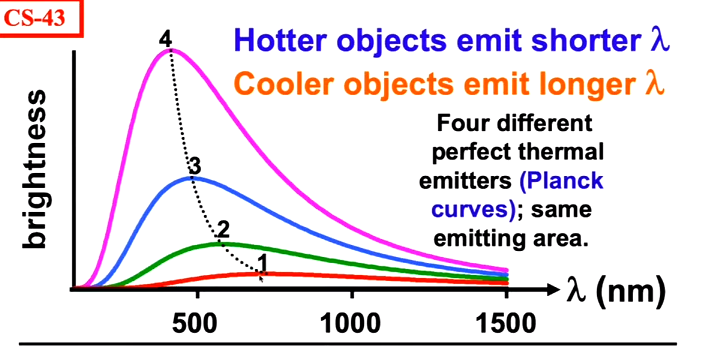
This relationship can be formally described by Wien’s Law, which states that the wavelength and temperature have an inverse relationship:
$$ \lambda_{peak} \times T = b $$- $\lambda_{peak}$ is the wavelength with the highest energy output,
- $T$ is the temperature of an object,
- $b$ is Wien’s Constant, approximately $3 \times 10^6 nm \cdot K$.
Why are some stars brighter than others? #
The luminosity of an emitter is the power, or the total energy emitted over time by the entire object.
The Stefan-Boltzmann equation (described in the previous section) explains how larger, hotter stars end up being brighter than smaller, cooler stars.