 ben's notes
Memory Safety Vulnerabilities
Buffer Overflow Attacks #
(For the underlying C memory model — pointers, addresses, stack layout — see Memory, Pointers, Addresses and Memory Management. Most of these attacks exploit unchecked pointer arithmetic on the runtime stack.)
out-of-bounds write #
Overwriting bytes in a later position by making the current value much larger than anticipated.
- This works because C doesn’t check memory boundaries.
- Vulnerable code:
gets()writes bytes until it encounters a newline. If there’s no newline, then it may overwrite far more than intended. - The following is an example. Attackers can simply write 21 ones into
nameand write a 1 intoauthenticated, thus logging in.
char name[20];
int authenticated = 0;

void bad(void) {
	...
	gets(name);
  ...
}
Stack Smashing #
When overflows overwrite RIP to jump to a new address and run a custom script.
- Most common type of buffer overflow
- Python style ASCII note:
\xmeans hex. So\x41 == 'A'for example - x86 is little endian so the addresses need to be broken up. If we wanted to store
0xdeadbeefinto an address, it would look like\xef\xbe\xad\xde.
Steps for stack smashing attack:
- Find a memory safety vulnerability
- Write malicious shellcode (runs a shell script) at a known memory address
- Overwrite RIP with address of shellcode
- Return from original function (will execute shellcode)
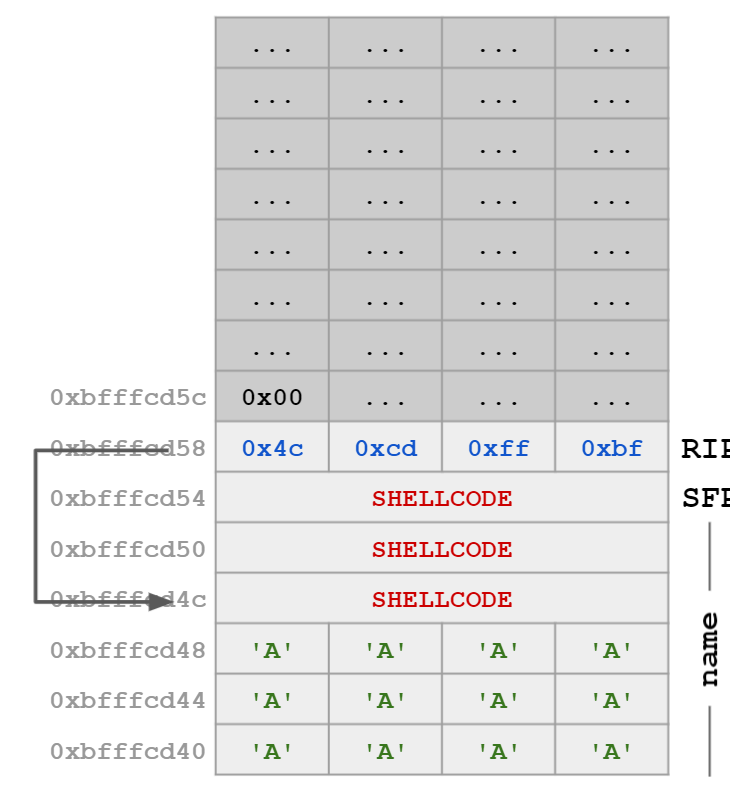
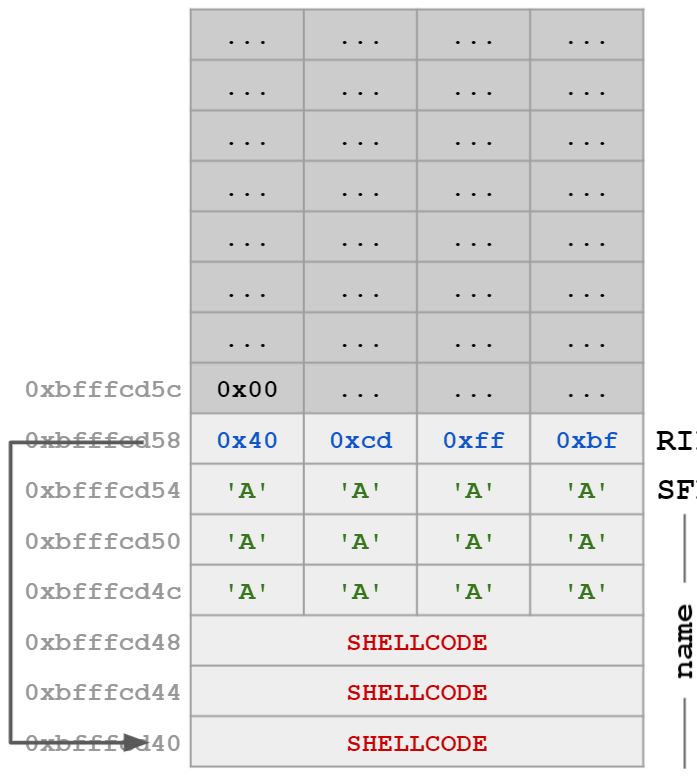
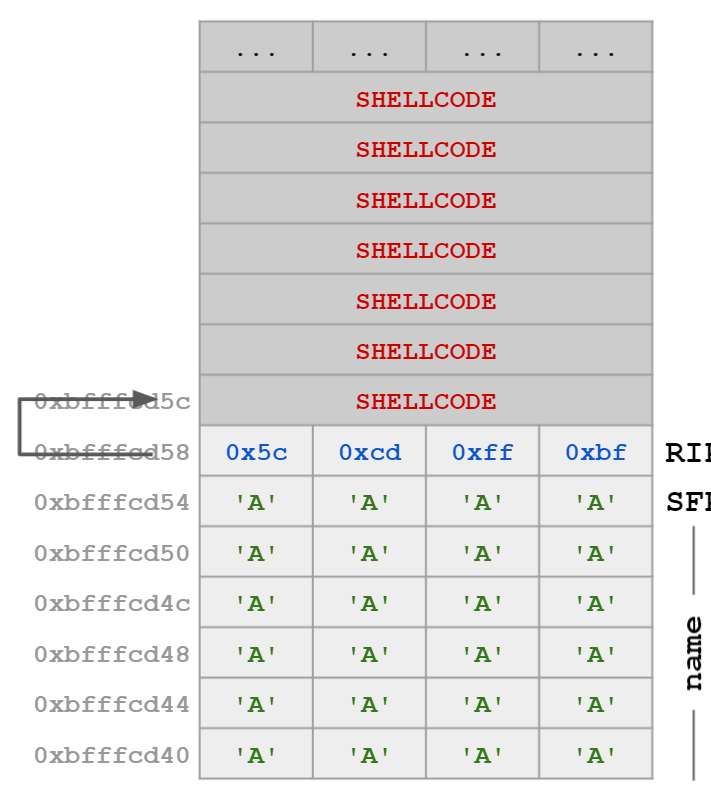
Three methods of stack smashing placement:
Memory-Safe Code #
- Rather than using
gets, usefgetswhich allows you to specify a maximum size. - Use
strncpy(more compatible, less safe) orstrlcpy(less compatible, more safe) instead ofstrcpy - Use
strnleninstead ofstrlen - tl;dr use boundary checking!
Signed/Unsigned Vulnerability #
Observe this code:
void f(int len, char *data) {
  char buf[64];
	memcpy(buf, data, len);
}
len is signed, but memcpy takes in a size_t which is unsigned. Therefore, if an attacker passes in a negative number to len, it will be cast to a very large positive number and lots of data will be dumped.
Integer Overflow Vulnerability #
If we pass in a int len and then malloc(len + n) where n is any positive number, then we would enable an integer overflow. If an attacker passes in 0xFFFFFFFF, then malloc will overflow the heap.
The way to fix this vulnerability is to add a check for if(len > SIZE_MAX - n) before proceeding.
String Format Vulnerabilities #
If the arguments into printf are mismatched, undesired behavior may occur
Example: printf("%d\n"); without a second integer argument will cause printf to look 4 bytes up the stack anyways and print whatever was there before (could be secrets)
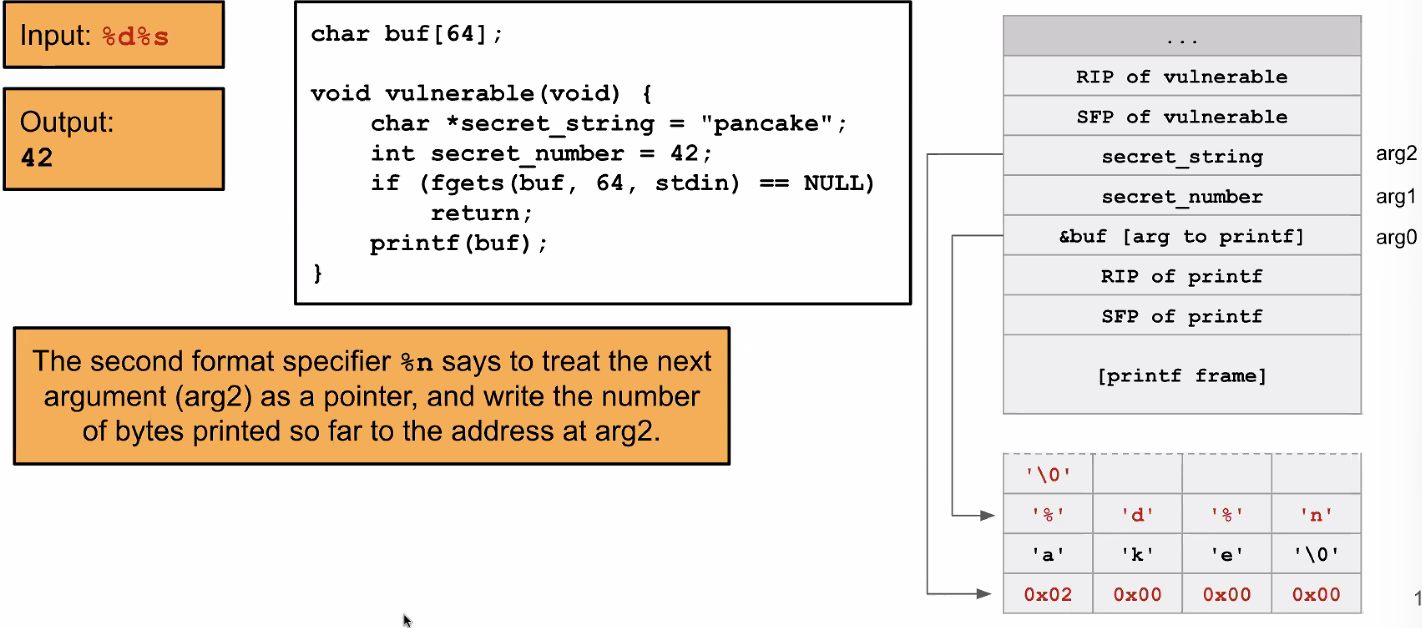
printf("%s") will look 8 bytes above the RIP of printf and continue printing until a null byte is reached.
%n treats the next argument as a pointer and writes the number of bytes printed into that address. For example, printf("item %d:%n", 987, &val) will write 9 bytes into &val (item = 4, space = 1, colon = 1, 987 = 3)
Defending Against String Format Vulnerabilities:
- Hard-code all string formats so user can’t exploit with input
- Sanitize inputs to remove all formatting