 ben's notes
Security Principles
What is security? #
Security is enforcing a desired property (confidentiality, privacy, integrity, authentication, availability) in the presence of attackers.
Some things that security helps protect:
- Physical safety (prevent disruption of cars, planes, etc)
- Personal information (health records…)
- National security
Everything is hackable, especially if it’s connected to the internet.
Threat Model #
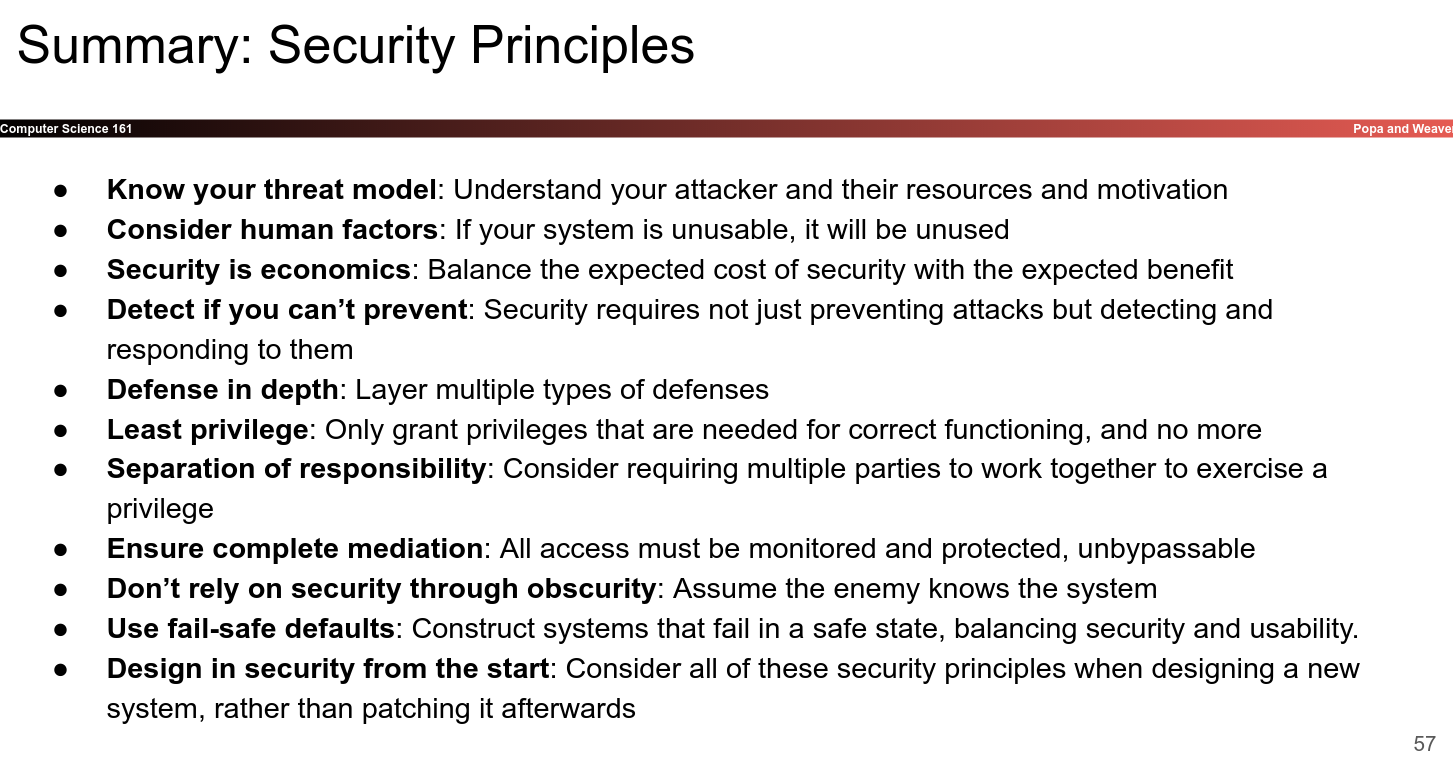
It is important to understand the motives and methods behind attacks, and make general assumptions about them to be safe. A threat model is a model of the attacker and the resources they have.
Assumptions #
- The attacker can interact with systems without notice.
- The attacker knows information about your systems (OS, vulnerabilities, patterns of use…)
- The attacker is able to get lucky (1 in a million = vulnerable).
- The attacker has all resources and computing power needed to mount the attack.
Basic Security Principles #
Trusted Computing Base #
The trusted computing base (TCB) is the core components of a system that it relies on. A good TCB has correctness (does what you want it to), completeness (can’t be bypassed), and security (can’t be compromised).
- The TCB should be made as small and simple as possible.
- Typically, the TCB is the OS or some component of the OS (e.g. kernel mode).
Human Factors #
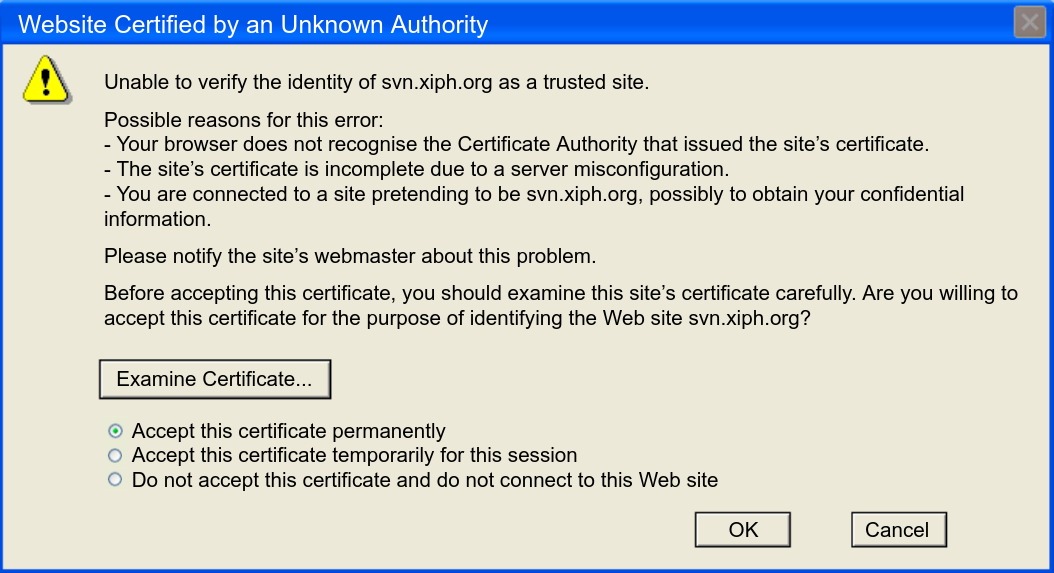
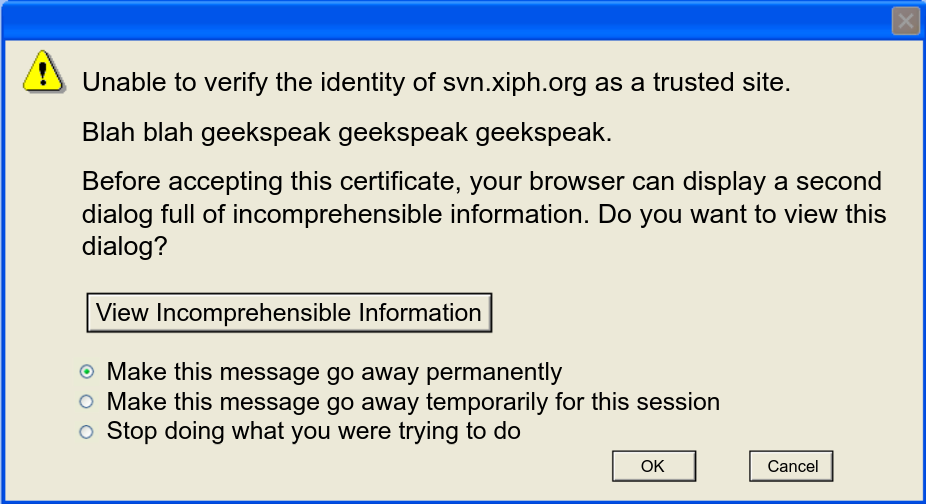
- A security system should be easy to use, otherwise users will not actually use it and/or find ways to get around it! It should also be foolproof to prevent incorrect usage from causing issues.
- Security systems should be robust to bugs and programming errors of the developers who create around it.
- Also need to protect against social engineering attacks (gain users’ trust, get access that way)
💡 Case study: memory dialogs. The following dialog will appear to users as this:
Security is Economics #
- The cost of defense should be less than the cost of attacks.
- If attack costs more than the reward, it does not make sense to attack.
- Example: we wouldn’t put a $10 lock for a $1 item
Detect if you can’t prevent #
- Deterrence: stopping attacks before they happen
- Prevention: stopping attacks when they happen
- Detection: learn about an attack after it happened
- Response: doing something about an attack after it happened
- Example: having emergency supplies after earthquake, keep backups in case of ransomware
Defense in Depth #
- More defenses = better
- Diminishing returns: 2 walls is better than 1, but 101 walls is not that much better than 100 walls
Separation of Responsibility #
(Distributed Trust): privilege should be shared between multiple parties, to prevent one from making poor decisions on their own
- Example: nuclear weapons require two people to simultaneously activate to launch
Ensure Complete Mediation #
Every access point should be protected. Otherwise, security measures will just be bypassed
- Reference monitor: a single point that all access must occur through (firewall, airport security…)
- Reference monitors should be correct, complete, and secure (just like a TCB)
Least Privilege #
Grant as little privilege as possible to as few people as needed, otherwise attackers may already have access they were unnecessarily granted.
Security through obscurity #
(Don’t do it!) Also known as Shannon’s Maxim / Kerckhoff’s Principle
Design in security from the start #
Include security as part of the initial design, rather than adding it afterwards