 ben's notes
TCP
The Transport Layer #
The transport layer (L4) is built directly on top of the networking layer. Many different protocols exist on the transport layer, most notably TCP and UDP. (For the security perspective — TCP injection, RST attacks, and how TLS sits on top of TCP — see Networking.)
The goal of the transport layer is to bridge the gap between the abstractions application designers want, and the abstractions that networks can easily support. By providing a common implementation, the transport layer makes development easier.
The main tasks of the transport layer include:
- Demultiplexing (taking a single stream of data and identifying which app it belongs to)
- Port numbers carried in L4 protocol header
- Providing reliability
- Translating from packets to app-level abstractions
- Avoid overloading the receiver (flow control)
- Avoid overloading the network
TCP Segments #

Individual bytes in the bytestream are divided into segments, which are sent inside of a packet. (A TCP packet is just an IP packet whose data contains a TCP header and segment data.)
The maximum segment size (MSS) is equal to the MTU - (size of IP header) - (size of TCP header).
TCP Sequence Numbers #
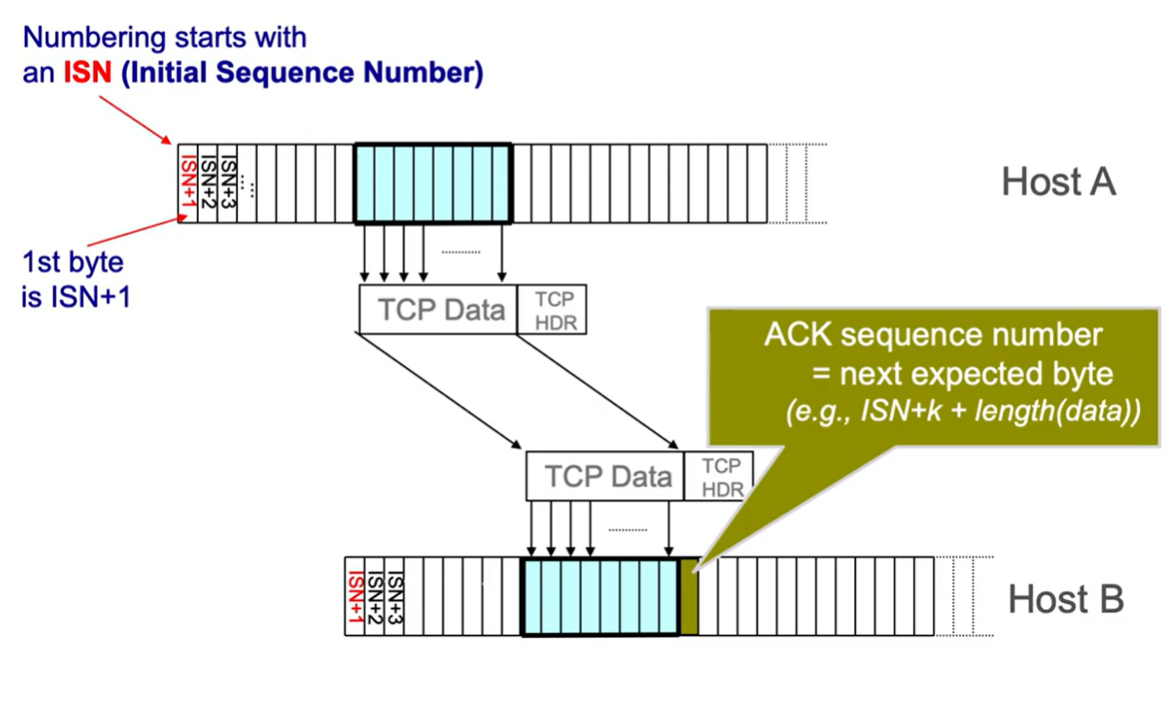
Important: TCP operates on bytes, not packets. Sequence numbers, ACKs, window sizes, etc. are all expressed in terms of bytes.
TCP Properties #
TCP is connection oriented #
TCP requires keeping state both on the sender and the receiver.
- Sender keeps track of packets sent but not ACKed, and any timers needed for resending.
- Receiver keeps track of out-of-order packets.
Each bytestream is called a connection or session, each with their own connection state stored at end hosts.
TCP connections are full-duplex #
If Host A and Host B are connected via TCP, hosts A and B can both be senders and receivers simultaneously. This means that Host A and Host B can be sending and receiving from each other using the same connections.
Reliability handling #
- Sequence numbers are byte offsets
- TCP uses cumulative ACKs (next expected byte: the sequence number of the next packet is the same as the last ack)
- Sliding window that allows up to $W$ contiguous bytes to be in flight at the same time
- Retransmissions are triggered both by timeouts and duplicate acks
- Single timer is used for the 1st byte of the window
- Timeouts computed from RTT measurements
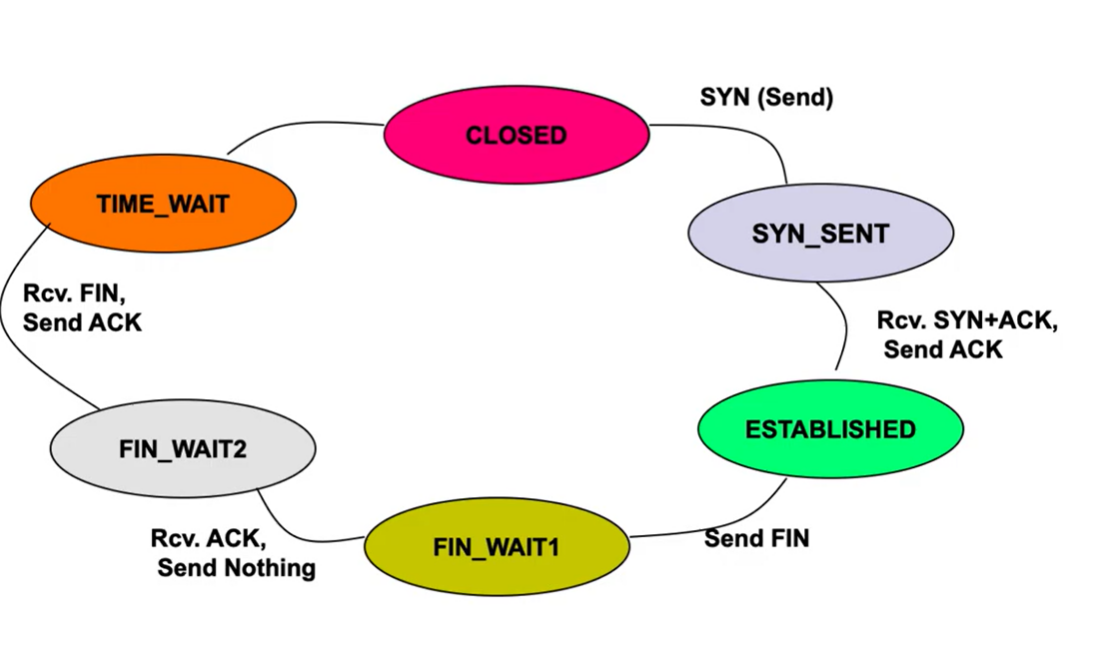
TCP States #
Congestion Control Implementation #
For an intro to congestion control, see congestion control.
TCP uses a loss-based, host-based, dynamic adjustment congestion control scheme.
Terms #
- Loss-based: window determined by packet loss
- Host-based: routers do not participate; window size is implicitly determined by hosts only
- AIMD: Additive Increase Multiplicative Decrease
- RWND: Advertised window/Receiver window: maintained by receiver and directly communicated to sender for flow control (max bandwidth the receiver can handle before buffer overflow)
- CWND: Congestion Window: computed by sender using concurrency control algorithm (how many bytes can be sent without overloading links)
- Sender-side window: min of RNWD and CWND. Typically, assume that RWND » CWND.
- MSS: Maximum Segment Size: max number of bytes of data that one TCP packet can carry in payload
- Sender Transmission Rate: CWND/RTT (bits per second)
- Changing CWND <==> changing transmission rate
- SSTHRESH: slow start threshold (last safe rate). equal to CWND/2 on first loss
Window Mechanics #
Recall that the sender maintains a sliding window of $W$ contiguous bytes, where $W$ is the window size (typically CWND). On receiving an ACK for new data $j$ where $j>i$, then the window slides to start at $j$.
The sender maintains a single timer for the smallest value $i$ in the window. On a timeout, the sender retransmits the packet that starts at byte $i$.
Since the receiver sends cumulative ACKs, full information isn’t provided so the sender will count the number of duplicate acks received (dupACK). When dupACK == 3, the sender will retransmit (fast retransmit).
Changing CWND #
Main idea: Change CWND based on ACK arrivals (ack clocking)
- The spacing between acks is representative of the bandwidth. Longer spacing = lower bandwidth
- Optimal solution = full utilization of minimum link bandwidth
Slow Start #
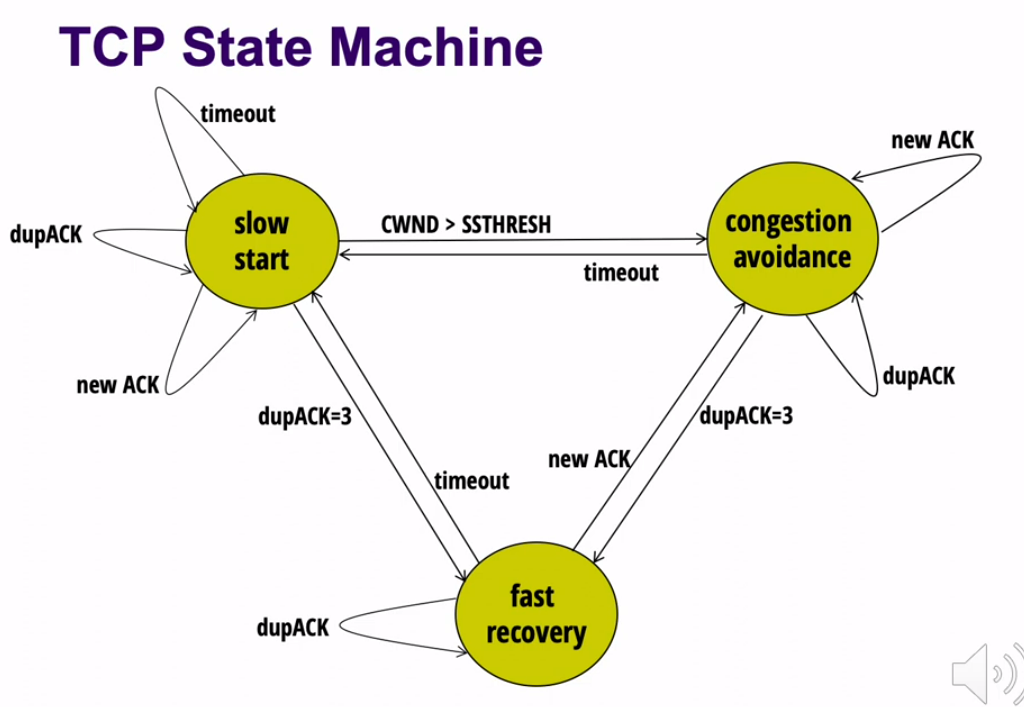
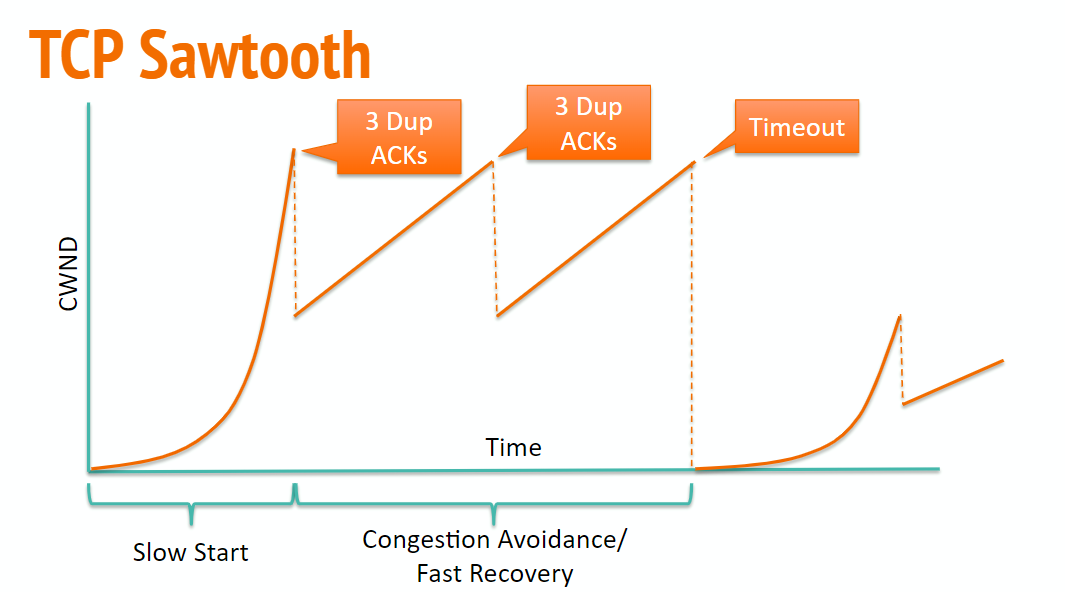
- Initialize CWND equal to MSS. (initial sending rate is one MSS per RTT)
- Double CWND every RTT until first loss occurs. (On every ACK, add 1x MSS to CWND)
- When first loss occurs, set SSTHRESH=CWND/2
AIMD/Congestion Avoidance #
- No loss -> increase CWND by 1 MSS every RTT
- Implementation: successful ACK received ->$CWND = CWND + MSS \times MSS/CWND$
- 3 dupACK -> divide CWND in half
- Implementation: save dupACKcount in memory, and increment if duplicate detected
- Timeout -> set CWND to MSS, and restart Slow Start
- switch back to AIMD when SSTHRESH is hit
Fast Recovery #
Fast Recovery is an optimization to congestion avoidance. The main idea is to keep packets in flight by allowing senders to keep sending even when a dupACK is received.
If dupACKcount is 3:
- set SSTHRESH to $\lfloor CWND/2 \rfloor$
- set CWND to SSTHRESH + 3xMSS
While in fast recovery:
- CWND = CWND + MSS for every additional dupACK
- Set CWND = SSTHRESH upon receiving first new ACK
State Machine #
TCP Sawtooth
TCP Throughput #
Given RTT and the loss rate $p$, we can derive the throughput of TCP.
Assume:
- loss occurs whenever CWND reaches $W_{max}$
- loss is detected by duplicate ACKS (no timeouts)
- ignore slow start throughput
Since we go between half of $W_{max}$ and full, the average window size per RTT is equal to $\frac{3}{4}W_{max}$. Therefore, the average throughput is $\frac{3}{4}W_{max} \times \frac{MSS}{RTT}$.
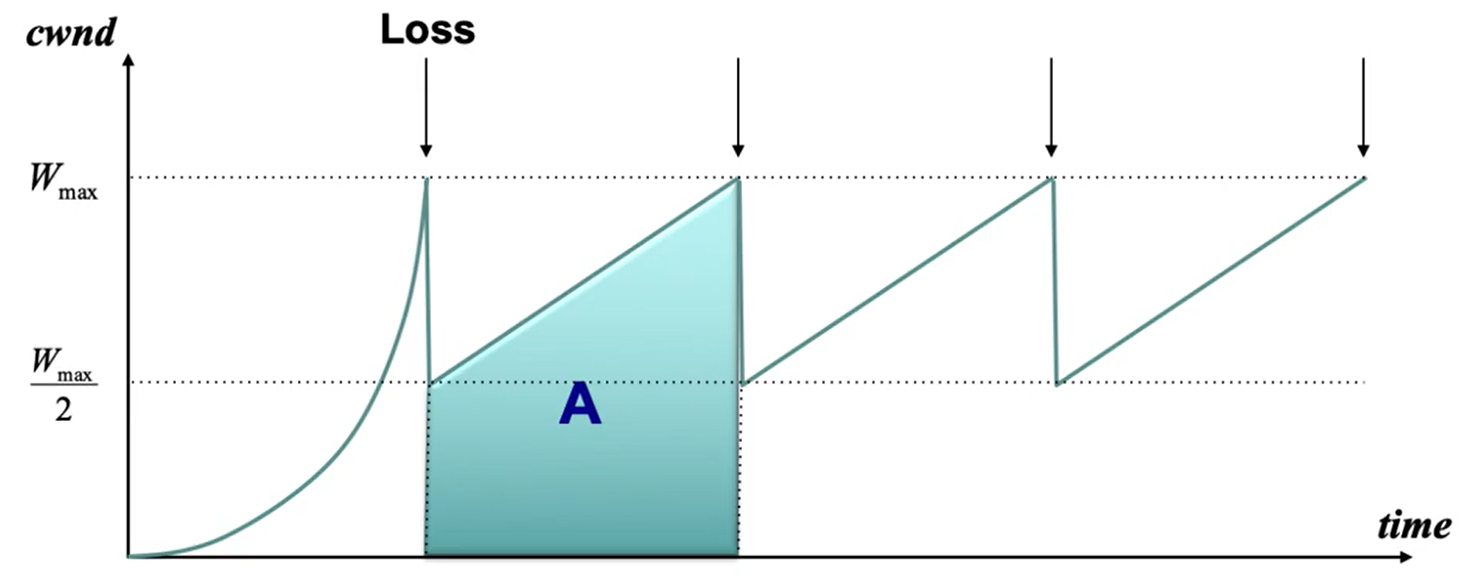 On average, our loss rate is $p=1/A$ (where A Is the area under the curve in one of the periods). Using this, we can see that the area $A$ is equal to $\frac{3}{8}W_{max}^2$.
Solving for $W_{max}$ and plugging it into the average throughput equation yields this formula for average throughput:
$$\sqrt{\frac{3}{2}} \frac{MSS}{RTT \sqrt{p}}$$Implications of throughput equation #
- Flows get throughput inversely proportional to RTT. So lower RTT = higher throughput, which can be unfair for further connections.
- Scaling a single flow to high throughput is very slow with additive increase, and ramping up to very fast bandwidth (hundreds of gbps) could take hours.
- solution: HighSpeed TCP (RFC 3649): past a certain threshold speed, increase CWND faster.
- TCP throughput is choppy due to repeated swings: some apps (streaming) may prefer sending at a steady rate
- solution: equation-based congestion control (measure RTT and drop percentage $p$ and directly apply equation)
- TCP confuses corruption with congestion: throughput is proportional to 1/sqrt(p) even for non-congestion losses
- Due to 50% of flows being <1500B, many flows never leave slow starts, and there are too few packets to trigger dupACKs
- solution: use higher initial CWND
- since TCP fills up queues before detecting loss, delays can be large for everyone in a bottleneck link
- solution: Google BBR algorithm (sender learns minimum RTT, and decreases rate when observed RTT exceeds minimum RTT)
- congestion control is intertwined with reliability: CWND is adjusted based on acks and timeouts. we can’t easily get congestion control without reliability.
Fairness #
General approach:
- A router classifies incoming packets into flows.
- Each flow has its own queue in the router.
- The router picks a queue in a fair order and transmits packets from the front of that queue.
Max-Min Fairness #
Main idea: if a flow doesn’t get its full demand, then no other flow will get more than that amount.
If the total available bandwidth is $C$ and each flow $i$ has a bandwidth demand $r_i$, then the fair allocation of bandwidth $a_i$ to each flow is calculated as
$$a_i = min(f, r_i)$$where $f$ is the flow’s fair share, calculated by the following:
- Get the average $C/N$ (where $N$ is the number of flows).
- Subtract all of the $r_i$ from $C$ where $r_i < N$. For each flow that this is done for, subtract one from $N$.
- For all of the remaining flows, set $f = C/N$.
Fair Queueing (RCP) #
FQ addresses the issue where packets may not all be the same size.
- For each packet, compute the time where the last bit would have left the router if flows are served bit by bit (deadlines)
- Serve packets in increasing order of their deadlines.
Advantages of FQ:
- Isolation of flows (cheating flows don’t benefit)
- bandwidth share does not depend on RTT
- flows can pick any rate adjustment scheme
Disadvantages:
- more complex than FIFO
- only helps, but does not solve, congestion control
- too complex to implement at high speeds
- unfair for applications with different numbers of flows
Explicit Congestion Notification (ECN) #
- Single bit in packet header set by congested routers in ACK
- Host treats acks with set ECN bit as a dropped packet
- Doesn’t confuse corruption with congestion
- Early indicator of congestion can be used to avoid delays
- lightweight to implement