 ben's notes
Algorithms for Integer Arithmetic
💡 Creating good algorithms requires two main building blocks: correctness and efficiency.
Addition #
We would like to define an algorithm $A_{add}$ such that…
$(\forall x,y)(A_{add}(x,y) \to x+y)$
A naive approach #
One straightforward way to add is to “count by fingers”- that is, keep adding one continually until you reach the end of the number.
Given $n$ digits, this algorithm, in the worst case, must add one $10^n - 1$ times. This is quite inefficient! Let’s see if we can do better.
The carry method #
This is the ’long addition’ we learned in elementary school: for each digit location, we sum up the digits at that location, then carry over the tens digit (if any) to the next location.
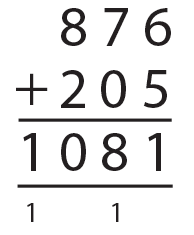
Since in the Arabic numeral system there’s a constant limit to how large each digit can be (at most 9), the runtime for an individual digit must be constant time $\Theta(1)$.
There are $n$ digits, and each digit takes $\Theta(1)$ time, so the runtime for summing two inputs must be $\Theta(n)$.
This is much better than the finger-counting approach, and actually is the most efficient known algorithm for addition!
Multiplication #
$(\forall x,y)(A_{mul}(x,y) \to x \cdot y)$
Some naive approaches #
If, like for addition, we are trying to multiply x and y together and simply add $x$ a total of $y$ times, then the efficiency has an upper bound runtime of $O(10^n \cdot n)$ where $n$ is the cost to add $x$ one time.
So let’s consider doing long multiplication, where we multiply each digit of $x$ individually with $y$, and add them all up:
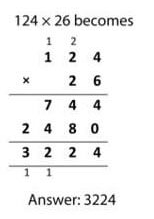
This becomes $O(n^2)$ since
💡 The formal definition of Big O is: $O(f(n)) \iff \exists c,N (\forall n \ge N)(T(N) \le c \cdot f(n))$
Karatsuba Multiplication #
This is an example of a powerful technique called divide and conquer.
The main premise of this algorithm is a recursive way to break down a number into smaller bits, and multiplying those bits all together using distribution.
For example:
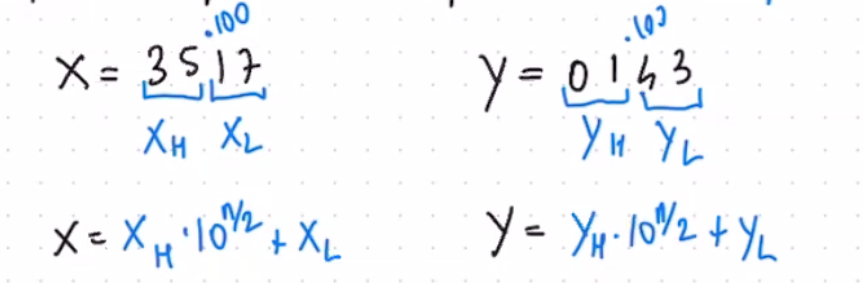
If we are trying to get $x \cdot y$:
$x \cdot y = (x_H \cdot 10^{n/2} + x_L)(y_H \cdot 10^{n/2} + y_L)$
Distributing this yields:
$x \cdot y = x_H \cdot y_H \cdot 10^n + (x_H y_L + x_Ly_H) \cdot 10^{n/2} + x_Ly_L$
If the number is larger than 4 digits, we can continue applying this by breaking down the ‘high’ and ’low’ even further into their own two parts.
Runtime:
For a single operation, the runtime will be $O(c \cdot n)$
The recursive tree structure will look something like this:
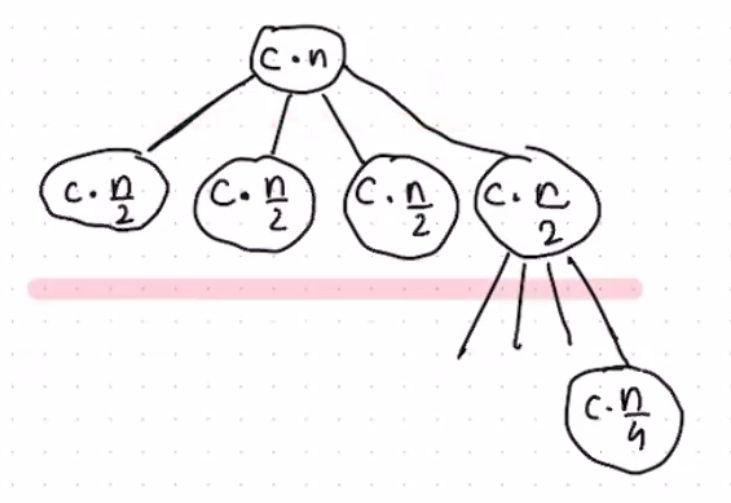
Each node splits into four smaller numbers ($x_H, x_L, y_H, y_L$). There are $log_2(n)$ layers total, and a single layer $i$ has a runtime of $2^i c \cdot n$.
So the total runtime is:
$$ ⁍ $$If we recall the geometric sum formula,
$$ \sum_{i=0}^{log_2(n)} 2^i = \frac{2^{log_2(n)+1} - 1}{2 - 1} \le 2n $$Plugging this back into the original runtime equation yields a runtime
$O(2n^2 \cdot c) \equiv O(n^2)$
Oops! This isn’t any better. But it’s directly related to a much better algorithm:
Better than $n^2$? #
If we realize that we don’t actually need to compute $x_Hy_L$ and $x_L y_H$ since we only need their sum, we can do this instead:
- Compute Karatsuba($x_H, y_H$). (A)
- Compute Karatsuba $(X_L, Y_L)$ (B).
- Compute Karatsuba $(x_H + x_L, y_H + y_L)$ (C).
- Find the original Karatsuba($x, y$) as $A \cdot 10^n + (C - A - B) \cdot 10^{n/2} + B$.
What does this do? Well, it makes the branching factor 3 instead of 4.
Since there is a $(3/2)^{log_2(n)}$ factor in the calculation now, it doesn’t simplify as nicely. But it becomes $O(n^{log_2(3)})$ which is less than $O(n^2)$ ($log_2(3)$ is about $1.58$.