 ben's notes
Duality
Primal and Dual: An Example #
Suppose we have an original, known as a primal, linear program with variables $x_1, \cdots, x_n$ and some constraints on those variables.
As an example, let’s say we are trying to maximize $2x_1 + 4x_2$ such that:
- $x_1, x_2 \ge 0$
- $x_1 \le 50, x_2 \le 80$
- $x_1 + x_2 \le 100$
We can rewrite the objective function as a linear combination of the constraints:
- $y_1 \cdot (x_1 \le 50)$
- $y_2 \cdot (x_2 \le 80)$
- $y_3 \cdot (x_1 + x_2 \le 100)$
Such that $y_1, y_2, y_3 \ge 0$ so that the inequalities do not flip.
Combining all of these inequalities creates the big inequality:
$(y_1 + y_3) x_1 + (y_2 + y_3) x_2 \le 50 y_1 + 80 y_2 + 100 y_3$
(The above inequality is constructed by separating the $x$ terms by the inequalities that affect them, and recognizing that the largest possible value of them is the sum of all inequality bounds.)
Looking at the original objective function $2x_1 + 4x_2$, we can substitute the $y$ values from the above inequality to get the equivalent statements:
- $y_1 + y_3 \ge 2$
- $y_2 + y_3 \ge 4$
(Since the objective function wants to maximize, it’s OK to have larger values.)
Then, we can set the right side of the big inequality to the new objective function:
$\min(50y_1 + 80y_2 + 100y_3)$
This is actually another linear program, called the dual LP.
Properties of the Dual #
- If two solutions to the primal and dual LP have the same value, then they are both optimal.
- If either the primal or dual is feasible, then the other must also be feasible.
- The max-flow min-cut theorem uses dual as a solution: the min cut capacity is the dual of the max flow, and so one can be used to solve the other.
- Duality Theorem: If the primal LP has a bounded max, then the dual LP has a bounded min, and the two values are equal.
The General Case #
How do we find the dual of any generic primal LP?
Suppose we have a primal LP:
- Objective function: maximize $C_1x_1 + \cdots + C_kx_k$
- A set of constraints $I$ (inequalities) that are in the form $I_i: a_{i1}x_1 + \cdots + a_{ik}x_k \le b_i$
- A set of constraints $E$ (equalities) that are in the form $E_i:a_{i1}x_1 + \cdots + a_{ik}x_k = b_i$
- A set of constraints $N$ (non-negative) that are in the form $N_j: x_j \ge 0$
We can apply the following transformation to convert this into the dual LP:
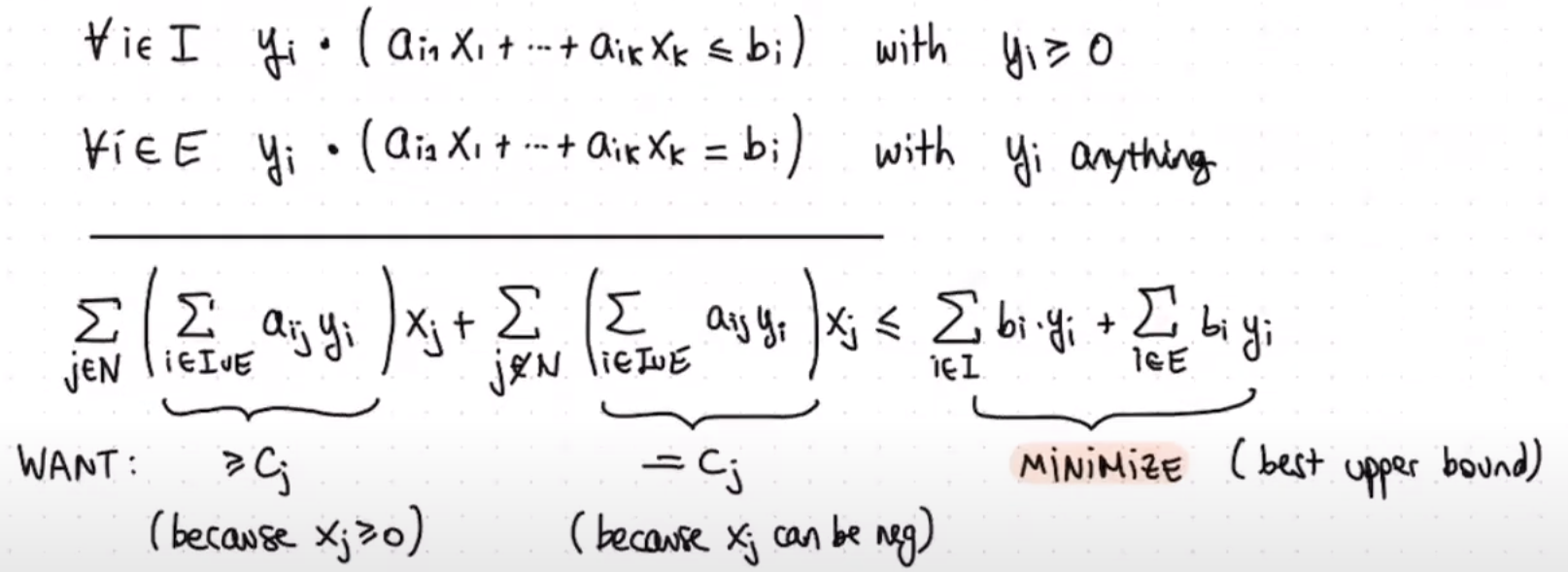
- Each primal constraint $i$ gets one multiplier variable $y_i$.
- For all non-negative constraints, the transformed primal constraint is $\ge c_j$.
- For all full-range constraints, the transformed primal constraint is $= c_j$.
- The objective function minimizes the induced right hand side of the sum.
Here is the statement of the general dual LP:
- Objective function: minimize $b_1y_1 + \cdots + b_my_m$
- Non-negative: $\forall j \in N$, $a_{ij} y_1 + \cdots + a_{mj} y_m \ge c_j$
- Possibly negative: $\forall j \not\in N, a_{ij} y_1 + \cdots + a_{mj} y_m = c_j$
- All $y_i \ge 0$ for each inequality.
Vector Form #
If all constraints are inequalities and all variables are non-negative:
- The primal LP can be stated as maximizing the vector $< c, x >$ such that $Ax \le b$ and $x \ge 0$.
- The dual LP can be stated as minimizing the vector $