 ben's notes
Matrix Multiplication
General Method #
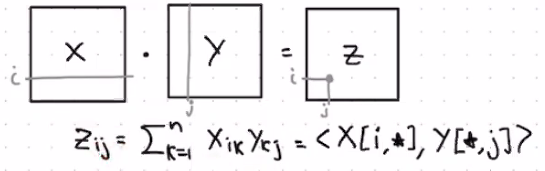
If we were just to multiply two matrixes by hand (let’s say we are trying to find $XY$), then we would need to multiply the $i$th row of $X$ with the $j$th column of $Y$ to get the $i,j$ position of the result $Z$.
Naive Algorithm #
A straightforward way of going by this is simply to loop through every possible value of $i$ and $j$:
for i in range(n):
	for j in range(n):
		for k in range(n):
			z[i][j] += x[i][k] * y[k][j]
This has a runtime of $O(n^3)$. Oof.
Recursive Algorithm #
Let’s try employing divide and conquer to make this problem better! Instead of doing each row and column individually, what if we split up the matrix into smaller matrices:

By the general form of the recurrence relation, we can write the runtime as:
$T(n) = 8T(n/2) + O(n^2)$
since we are splitting the work into 8 separate matrix multiplications ($AE, BG...$) and the dimension of each subpart is $n/2$. We then require $n^2$ time to put these parts back together.
If we let $a=8$, $b=2$, and $d=2$, then by the Master Theorem $O(n) = n^{log_b(a)} = n^{log_28} = n^3$. Whoops…
Strassen’s Algorithm #
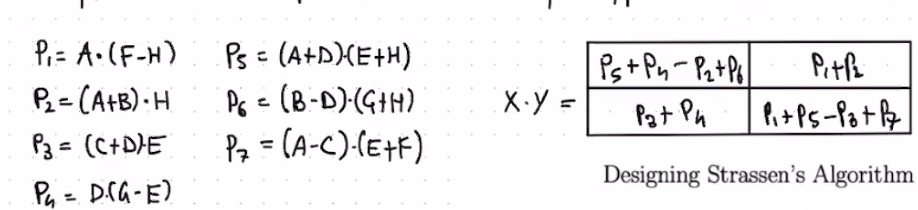
Somehow, if we rewrite the products as such, we only need to compute 7 products rather than 8!
This means that the Master Theorem should evaluate to $O(n^{log_27})$ which is about $n^{2.81}$. This is less than $n^3$ so it’s an improvement (albeit a small one).