 ben's notes
Path Tracing
Reflection #
Reflection is the process by which light incident on a surface interacts with the surface such that it leaves on the same side without change in frequency.
Cagetories of reflection #
Ideal specular: perfect mirror reflection Ideal diffuse: equal reflection in all directions Glossy specular: majority of light reflected near mirror direction Retro-reflective: light bounces back towards the way it came
Reflection at a point #
incoming differential irradiance:
$$dE(\omega_i) = L(\omega_i) \cos \theta_i d \omega_i$$Exiting differential radiance:
$$dL_r(\omega_r)$$BRDF #
Bidirectional reflectance distribution function: represents how much light is reflected into each outgoing direction $w_r$ from each incoming direction $\omega_i$
$$f_r(\omega_i \to \omega_r) = \frac{dL_r(\omega_r)}{L_i(\omega_i)\cos \theta_i d\omega_i}$$The Reflection Equation #
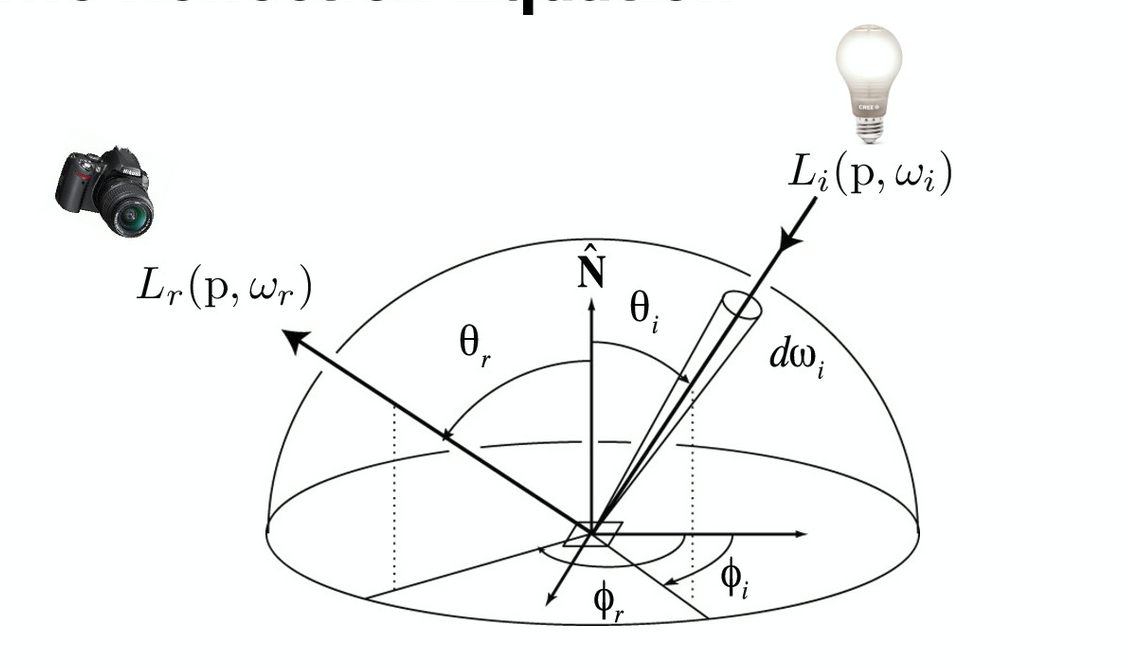
 The radiance received from a point $p$ at camera angle $\omega_r$ from the source is calculated as such:
- Over all incoming directions:
- Use the BRDF $f_r$ and the angle $\theta_i$ to calculate the incoming radiance to point $p$
Multiple Lighting Sources #
If we have multiple lights, we can randomly choose light $i$ with probability $p_i$, then randomly sample over that light’s directions with probability $p_L$. The weight for the lighting calculation will then be $1/(p_i p_L)$.
Global Illumination #
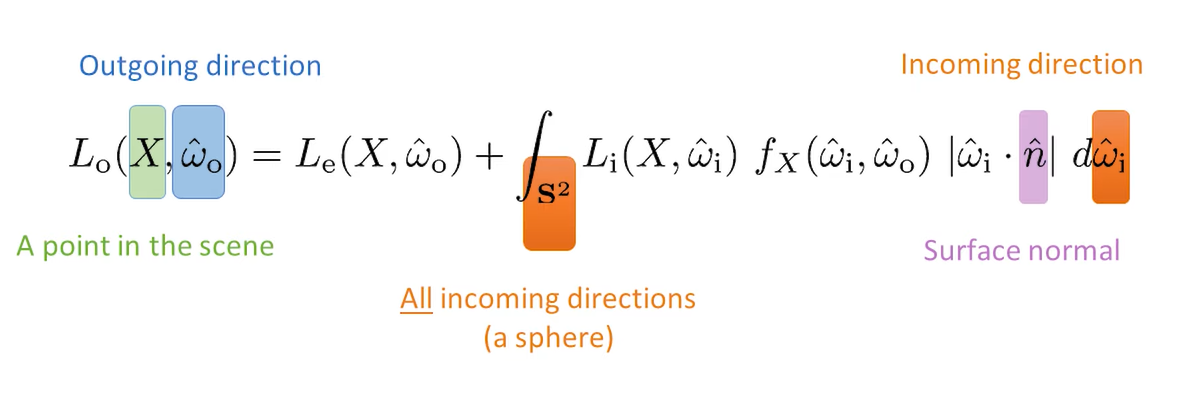
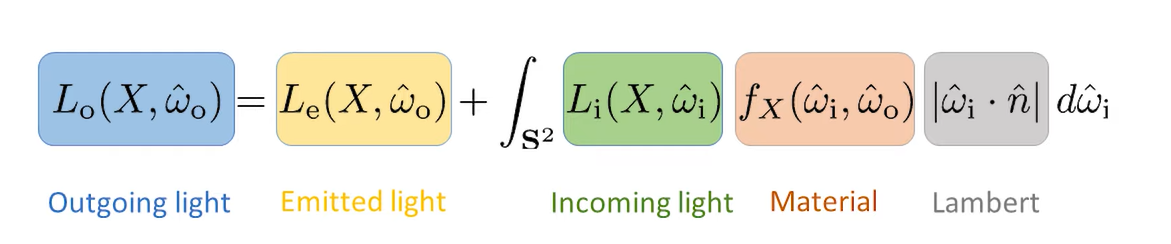
The Rendering Equation #

Let’s break that down:
https://www.youtube.com/watch?v=AODo_RjJoUA