 ben's notes
Radiometry and Photometry
Introduction #
Lights work by converting energy into photons, which each carry a small amount of energy away. Some of these photons reflect from objects and bounce into our eyes, which we perceive as light.
Radiometry is a measurement system for illumination, used to quantify the spatial properties of light. It can be used to perform lighting calculations to represent reality.
Assumptions #
- Assume a geometric optics model of light: photons travel in straight lines, and can be represented as rays.
- Assume a steady state flow: the rate of energy consumption of light sources is constant, so flux/power and energy can be interchangable.
Summary #
Radiometric units vs. Photometric units #
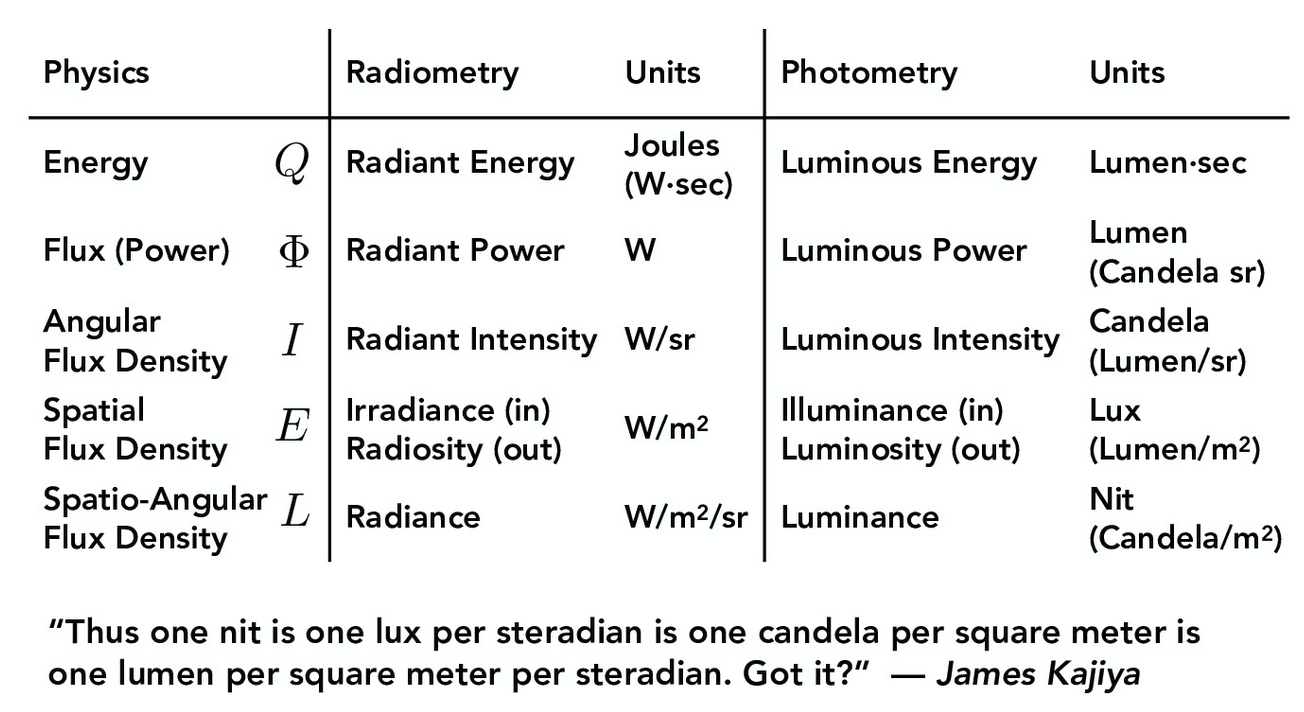
Radiometric units are the standard SI units for measuring quantities of energy in space. Every radiometric unit has a photometric equivalent, which accounts for the response of the human visual system.
radiant/luminous energy $Q$ (joules): amount of energy in the form of electromagnetic radiation.
radiant/luminous flux/power $\Phi$: (watts, lumens/lm) the density of energy: amount of energy emitted, reflected, transmitted, or received per unit time.
- Luminous flux $\Phi_v$ can be represented as $\int_0^\infty \Phi_e(\lambda)V(\lambda)d\lambda$, where $\Phi_e$ is the radiant flux, and $V$ is the efficiency curve (amount of light the eye can perceive at a given wavelength $\lambda$). $$\Phi = \frac{dQ}{dt}$$
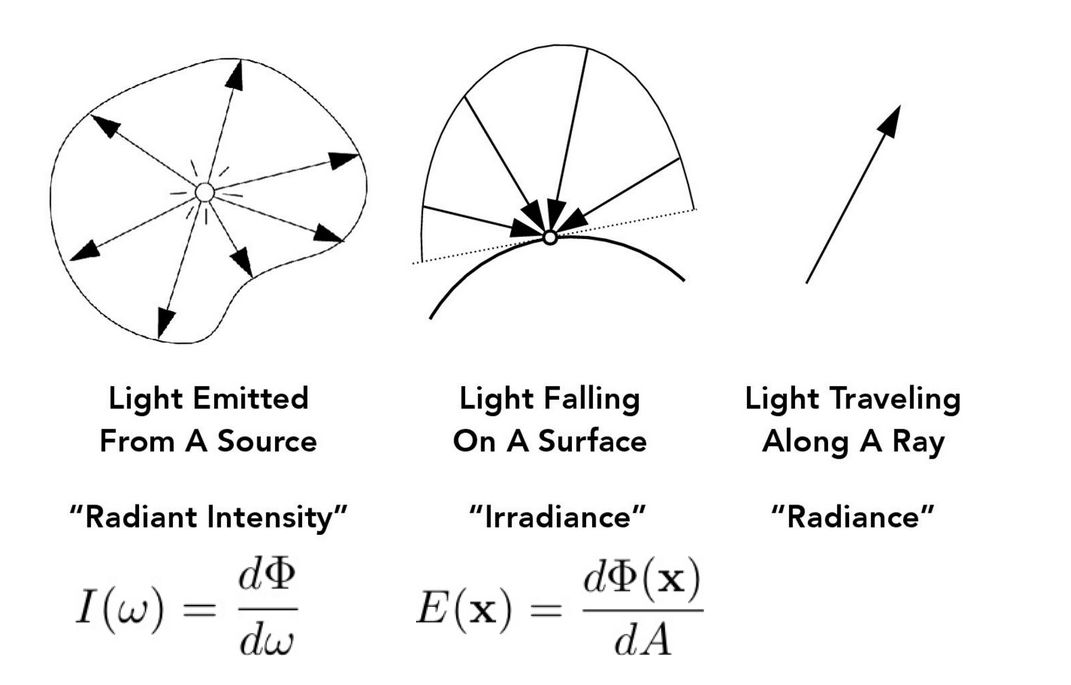
Radiant Intensity: $I$ (candela, cd) the power per unit solid angle emitted by a point light source.
- A solid angle is a block of 3D space within a sphere. $\omega$, a steradian, is like a radian but 3D.
- Definition of solid angle: $\Omega = A/r^2$ so a sphere as $4\pi$ steradians. $$I(\omega) = \frac{d\Phi}{d\omega}$$ The radiant intensity of an isotropic point source (emit light uniformly in all directions) can be derived as such: $$\Phi = \int_{S^2} I d\omega = 4\pi I; I = \frac{\Phi}{4\pi}$$
Irradiance #
Irradiance/Illuminance: $E$ (lux): power per unit area incident on a surface point
$$E(x) = \frac{d\Phi(x)}{dA}$$Irradiance Falloff: The intensity decreases by the square of the distance from the light source.
$$E' = \frac{E}{r^2}$$where $E$ is the irradiance over a sphere at radius $1$, $E = \Phi/(4\pi)$
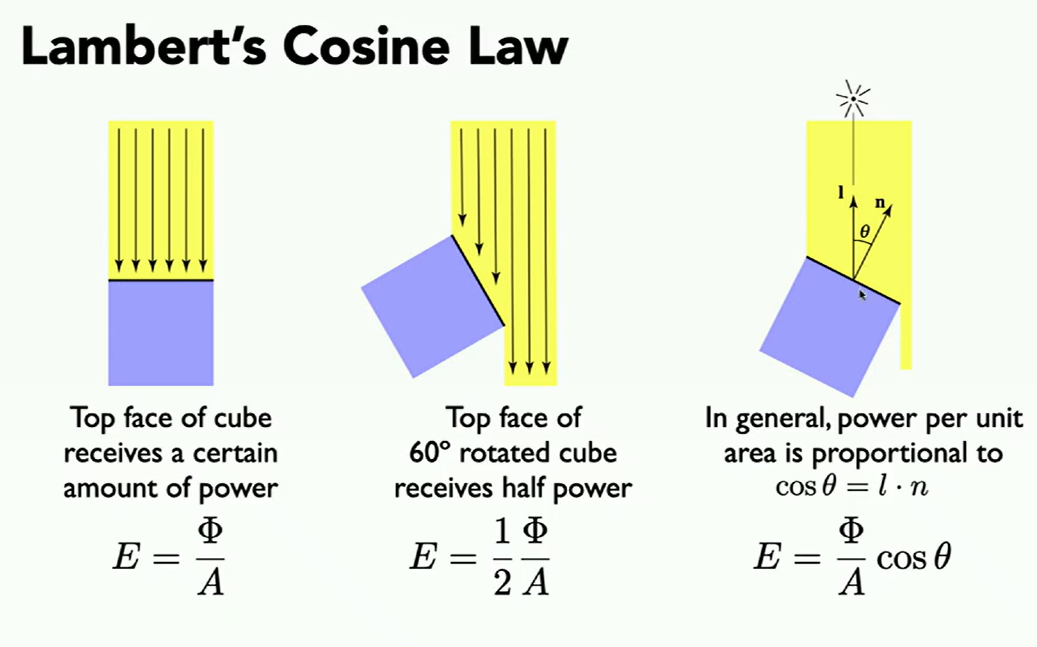
Lambert’s Cosine Law #
Radiance #
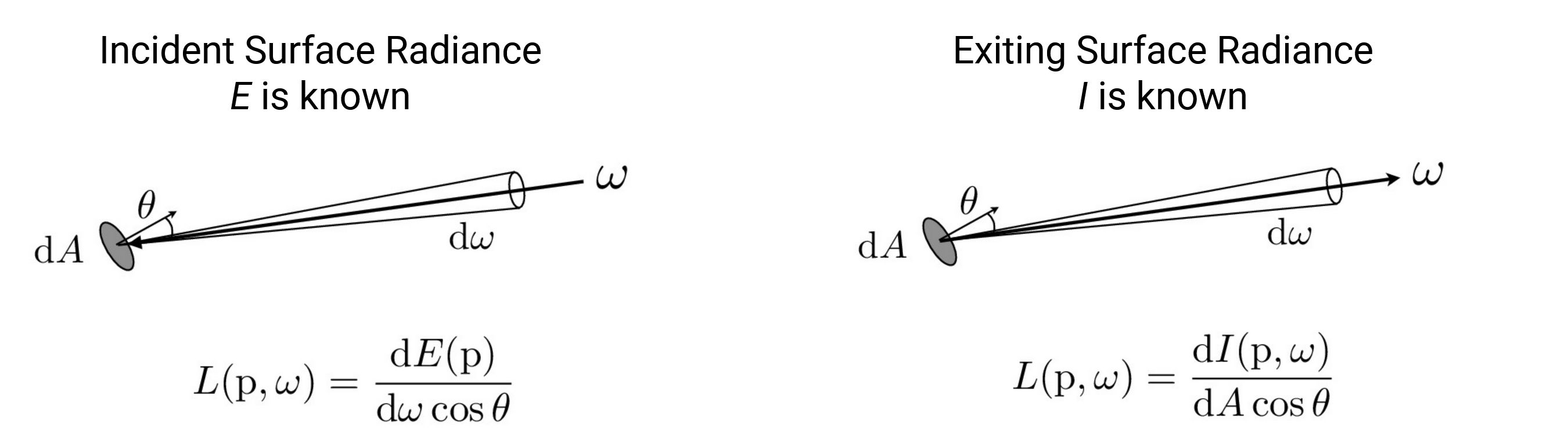
Radiance is the fundamental quantity that describes the distribution of light in an environment. Formally, it is the power emitted, reflected, transmitted, or received by a surface per unit solid angle per unit projected area.
$$L(p, \omega) = \frac{d^2 \Phi(p, \omega)}{d\omega dA \cos \theta}$$Unit: nit (lumens per steradian-meter^2)
Radiance is invariant along a ray in a vacuum.
To convert radiance into irradiance:
$$E(p) = \int_{H^2} L_i(p, \omega) \cos \theta d\omega$$