 ben's notes
Agents and Environments
Designing Rational Agents #
How do we actually build AI systems?
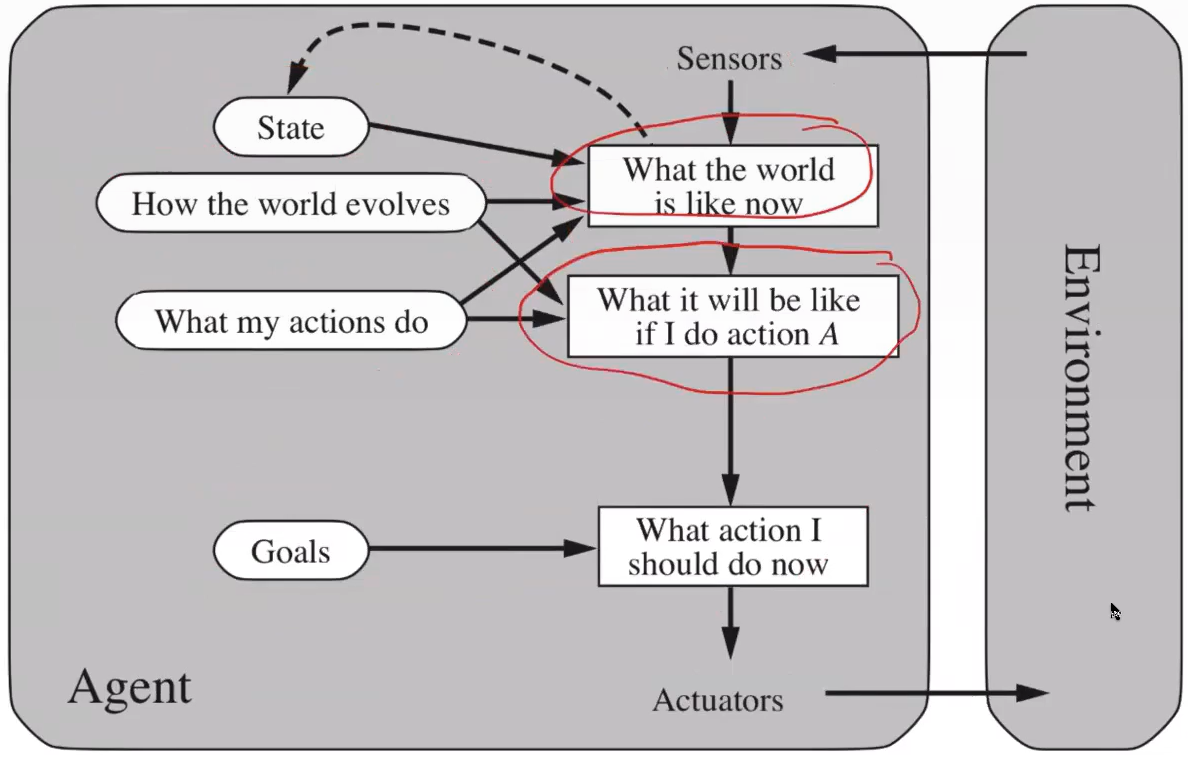
- An agent is any entity that perceives (through sensors) ****and acts (through actuators or effectors).
- One possible goal of making an AI is to create a rational agent - one that selects actions that maximize its expected utility.
- The agent function maps perception to action. It is generated by an agent program running on a machine.
Evaluating the Environment #
The task environment can be described using PEAS:
- Performance measure
- Environment
- Actuators
- Sensors
Example: Pacman #
Performance Measure: In Pacman, one potential way to measure performance is to positively weight collecting food, attacking ghosts, and winning, and negatively weight dying, taking steps, etc.
Environment: The rules and dynamics of the Pacman game (movement, ghost behavior, etc.)
Actuators: The controls to move Pacman up, down, left, and right
Sensors: The entire state of the game is visible except for the duration of the power pellet, which is random.
Environment Types #
The type of the environment largely determines the agent design.
- Fully vs. Partially observable: Whether or not the agent can see the entire state of the system. If partially observable, then the agent requires memory (internal state).
- Pacman is nearly fully observable (only the power pellet edge case).
- Single agent or multi agent: How many independent actors there are in the environment. Pacman is multi-agent (ghosts, player…)
- Deterministic or stochastic: If the outcome is the same given the same inputs.
- Pacman is deterministic, whereas something like a self-driving car environment would be stochastic.
- Static or dynamic: Whether or not the environment will wait for you to act.
- Pacman is dynamic (time keeps ticking), whereas something like Backgammon would be static.
- Discrete or continuous: Whether or not the inputs are processed in time steps, or constantly.
- Pacman is discrete (frame by frame), but self driving cars would have continuous time.
- Known physics: We know exactly how the environment behaves and the rules behind it.
- Pacman definitely has known physics.
- Known performance measure: Whether or not the end goal can be concretely defined.
- Pacman has a known performance measure (win or loss).
Reflex Agents #
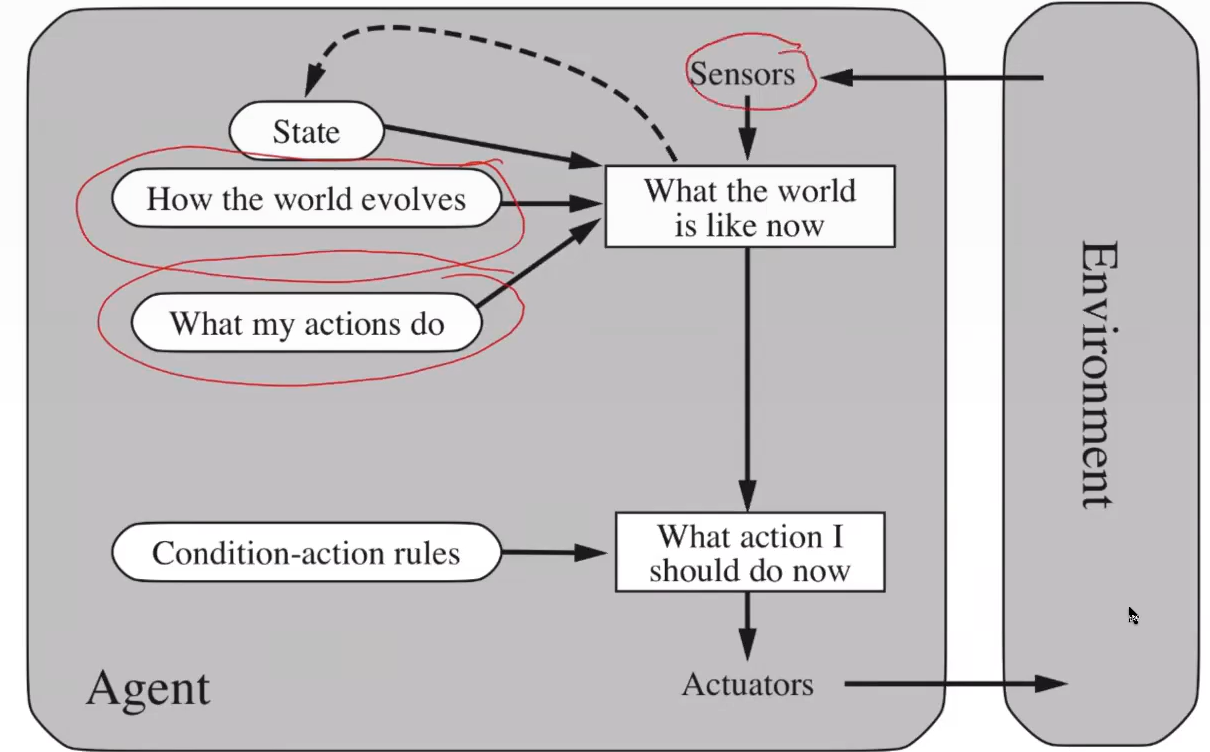
Reflex agents directly map percepts to actions. By principle, reflex agents can act optimally in a fully observable environment.
- Pacman is not fully observable, so a reflex agent would not be fully optimal (can’t predict whether to go towards a ghost or not, since we don’t know the duration)
Reflex agents can be extended with state to account for the current status of the environment.
Goal-Based Agents #
Spectrum of Representations #
There are three main ways to represent state:
- Atomic: A collection of individual states (Markov models, etc)
- Factored: A list of factors (booleans, continuous variables, etc.) that can be used to describe a variety of states (neural nets, Bayes nets…)
- Structured: sets of rules to describe every state (programming languages…)