 ben's notes
Neural Networks
General idea: Combine multiple simple regression models together to increase complexity of the overall model.
Optimization #
Gradient Ascent and Descent #
The difference: gradient ascent maximizes a log-likelihood function; gradient descent minimizes a loss function.
Gradient Ascent algorithm:
randomly init w
while w not converged:
	for weight in w:
		weight = weight + learning_rate * gradient(log_likelihood(w), weight)
- convergence is when gradient = 0, or no change occurs between two runs
- $w$ is a vector of $N$ weights
gradient(log_liklihood(w), weight)represents the operation $\nabla_{weight} \log l(\bold{w})$, which returns a vector of $N$ partial derivatives $\partial_{weight} \log l(w_i)$ for every weight $w_i$.
Gradient Descent algorithm:
randomly init w
while w not converged:
	for weight in w:
		weight = weight - learning_rate * gradient(loss(y, x, w), weight)
- Basically the same as gradient ascent, except subtract the gradient of loss instead of adding the gradient of log likelihood.
Stochastic gradient ascent/descent: only take one data point at a time to calculate the gradient. May cause inaccurate results.
Batch gradient ascent/descent: Randomly takes a batch size of $m$ data points each time to compute the gradients. Good compromise in terms of performance and accuracy.
Multilayer Perceptron #
Main idea: make perceptrons take outputs from other perceptrons as their input.
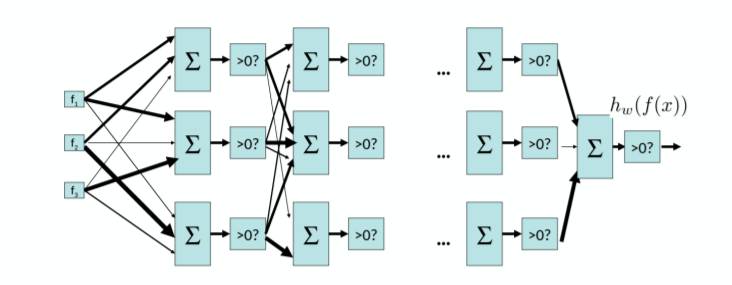
Universal functional approximator theorem: a two-layer neural network with enough neurons can approximate any continuous function to any desired accuracy.
In order to approximate nonlinear functions, each layer is separated by a nonlinear operator. Traditional neural nets have used the sigmoid function $\sigma(x) = \frac{1}{1 + e^{-w^Tx}}$, but due to faster computation the ReLU (rectified linear unit) function is often used instead. The graphs of these two functions are as follows:
For every layer, we wrap the parameters around a function call. For example, here is a 2-layer network:
$$ f(x) = relu(x \cdot W_1 + b_1) \cdot W_2 + b_2 $$- $x$ is an $1 \times i$ input vector
- $W_1$ and $W_2$ are $i \times h$ weight parameter matrices, where $h$ is the hidden layer size parameter
- $b_1$ and $b_2$ are $1 \times h$ bias parameter vectors