 ben's notes
Intro to C
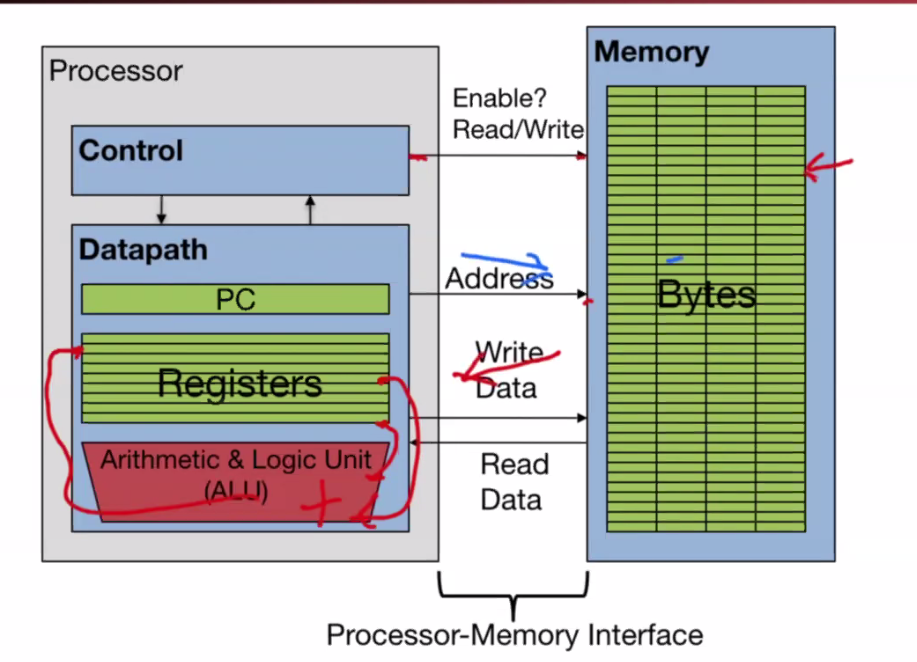
C: The Universal Assembly Language #
What’s the big deal with C?
- It’s wildly popular. C and its derivatives have been around for 40+ years and won’t be going away anytime soon.
- It’s highly configurable. Whatever you want to do, C can probably do it.
- It’s good if you have limited memory. Microprocessors are best used when running C because memory allocation is a must when you only have like 4kb of RAM.
Compilation #
C compilers map programs directly into machine code (bitstrings). In comparison:
- Java has architecture-independent bytecode that uses a JIT compiler to run.
- Python converts a program to bytecode at runtime.
This means that compiled C programs are architecture specific. Individual C files are individually compiled, then combined using a linker which creates one unified output executable.
Before the compiler processes the code, the code first runs through the C Pre-Processor (CPP). Everything beginning in a ‘#’ is a CPP macro (like #include, #define.. )
- These are not actual functions. They simply change the text of the program before compilation! This can create really weird errors: for instance, if we
#define f(x) y++then instead of creating a function that evaluates toy++, the CPP will rewrite all instances off(x)intoy++so you could get something likey++ + y++.
Variables #
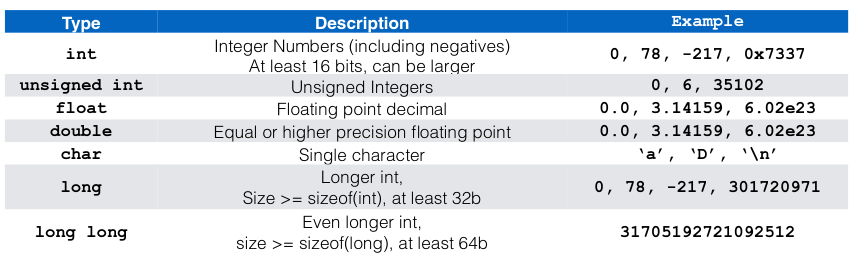
There are additionally different types of integers:
sizeof(long long) >= sizeof(long) >= sizeof(int) >= sizeof(short)- The actual size of any of these types are not guaranteed, except for
shortbeing at least 16 bits andlongbeing at least 32 bits. In practice, all could actually be the same size.
To define a variable:
int normalvar = 42;
const int constvar = 42;
enum colors {RED, GREEN, BLUE};

float do_the_thing (int x) {
	return 0.3;
}
Some important notes about variable declarations:
- All variables must be declared before they can be used. (same as Java)
- All declarations must be at the beginning of a block. (different from Java)
- If a variable is declared but not initialized, it holds undefined garbage.
Structs #
Since C predates OOP, standard objects don’t exactly exist. Instead, we have structs which define properties for a variable:
typedef struct thing {
	int stuff1;
	int stuff2;
	struct thing *next_thing;
} Thing;

Thing thing1;
thing1.stuff1 = 5;
thing1.stuff2 = 10;
...
A struct is just an instruction on how to arrange a bunch of bytes in a bucket. We can use sizeof(struct foo) to get the number of bytes used by foo.
Unions #
There are also unions, which are similar to structs except that it takes the same space as the largest element. (So if there were an int and char , a struct would take 5 bytes but a union would take only 4. Unions are like an or expression- the object is this or that (but not both)- whereas a struct is like an and expression- both this and that.
Unions can be used to create switchable types:
enum FieldType {type1, type2, type3};
union test {
	char *a;
	int b;
}
struct foo {
	FieldType type;
	union bar data;
}

struct foo *f;
switch(f->type) {
	case type1:
		...
}
Arrays #
Arrays are statically sized. An array object is simply a pointer to the 0th element.
- To declare an array:
int ar[32]makes a 32-integer array char *stringis almost the same aschar string[]- Doing array operations is basically just doing pointer arithmetic but nicer:
a[i]is similar to doing*(a+i)to access theith element.
⚠️ When an array is passed into a function, its size is lost. Therefore, a size must be explicitly passed into the function as an integer in order to use this information.
There is also no check for bounds. It is entirely possible to overwrite an unrelated piece of memory before/after an array if the length of the array is exceeded.
Strings #
A string in C is just an array of characters: char string[] = "abc".
- The last character is followed by a null terminator,
0or\0. - To get the length of a string: (both are equivalent)
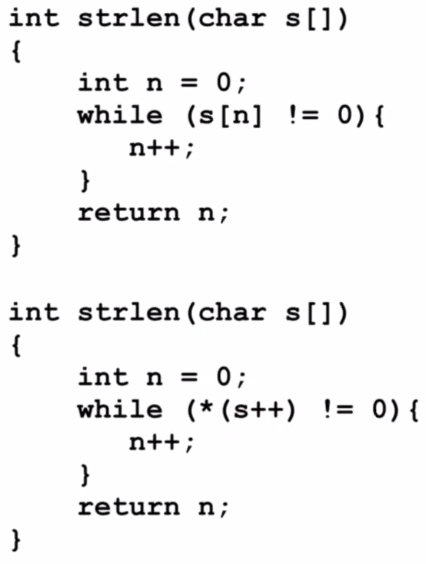
Copying a string: Suppose we have a string b that we want to copy to a. Then,
a = malloc(sizeof(char) * (strlen(b) + 1));
strcpy(a, b)
// alternative
strncpy(a, b, strlen(b) + 1);
Strings are not immuable! (except for constant strings which are global variables that cannot be written to)
String/char functions:
- getchar
- gets
- printf
- scanf
Undefined Behavior #
There are parts of C where the behavior is undefined. This means that the behavior is unpredictable and the compiler pretty much does whatever it wants. This can create issues like:
- programs running one way on one computer, and another way on another
- programs running differently each time
- programs running differently on different inputs