 ben's notes
Number Representation
Bases and Bits #
In Arabic numerals, we use base 10. So for example, $533 = 5 \times 10^2 + 3 \times 10^1 + 3 \times 10^0$.
There are also other common bases, where we multiply each digit by a different value. The most common are binary (base 2), octal (base 8), and hexadecimal (base 16).
💡 Bits are bits. They can represent literally whatever you want!
🔥 With $n$ bits, we can represent $2^n$ different things!
Signed and Unsigned Integers #
Integers can either be unsigned (positive only) or signed (positive or negative).
In a signed integer, the left-most bit is reserved as the sign bit where 0 is positive and 1 is negative.
There are some helpful properties we’d like signed numbers to follow:
- There should be a single zero (where all bits are 0).
- The zero should be treated as positive.
- Half of the numbers should be greater than 0, and the other half should be less.
Two’s Complement #
One of the most common representations for negative numbers is Two’s Complement, which makes operations like addition much more intuitive.
In Two’s Complement, the sign bit has negative weight. In other words, we take the largest possible number and subtract the numerical portion from that largest amount.
An easy way to compute Two’s Complement is to invert all bits and add 1.
For an example, let’s try to find the bit representation of $-3$.
$3_{ten} = 0011_{two}$
Invert all bits:
$1100_{two}$
Add one:
$1101_{two} = -3_{ten}$
Binary Addition #
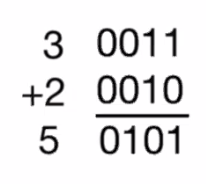
Adding two positive numbers is straightforward- same process as base 10:
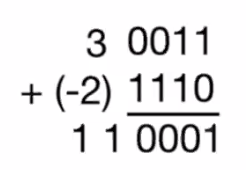
Adding negative numbers works too. There is a carry out bit if the result has more bits than we have available.
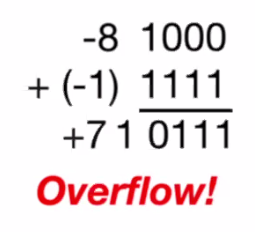
If the result is greater than the largest possible number the bits can store, an overflow occurs and the number wraps around: