 ben's notes
Principles of Developmental Psychopathology
Impact of Mental Disorders #
The prevalence of mental disorder in US youth #
Bitsko RH, Claussen AH, Lichstein J, et al. Mental Health Surveillance Among
Children —United States, 2013–2019.
- A difficult number to measure: while it is very likely that the rate of mental illness is increasing, our ability to diagnose larger numbers of individuals is also improving
- Current estimate: 1 in 5 children/adolescents experience a mental disorder each year
- 2 in 5 will meet criteria for a mental disorder by 18
- Half have onset before age 14 (onset = first noticeable difference in behavior; diagnosable)
- Significant difference of prevalence rates depending on sociodemographic characteristics (sex, race, ethnicity, urban vs rural, socioeconomic status)
The burden of mental illness #
(Vigo, Thornicroft, Atun 2016)
Disability-adjusted life years (DALYs): number of expected years of life lost/lived with disability or due to death
- Each type of disorder has its own calculated DALY estimate
- Mental illness is ranked 5 (below neonatal disease, cancer, common infections, and cardiovascular disease) in percentage of DALYs; ranked 2 when self-harm or chronic pain is taken into account
- This estimate has been criticized for underestimating the burden of mental illness
Principles of Developmental Psychopathology #
Normal and atypical development are mutually informative #
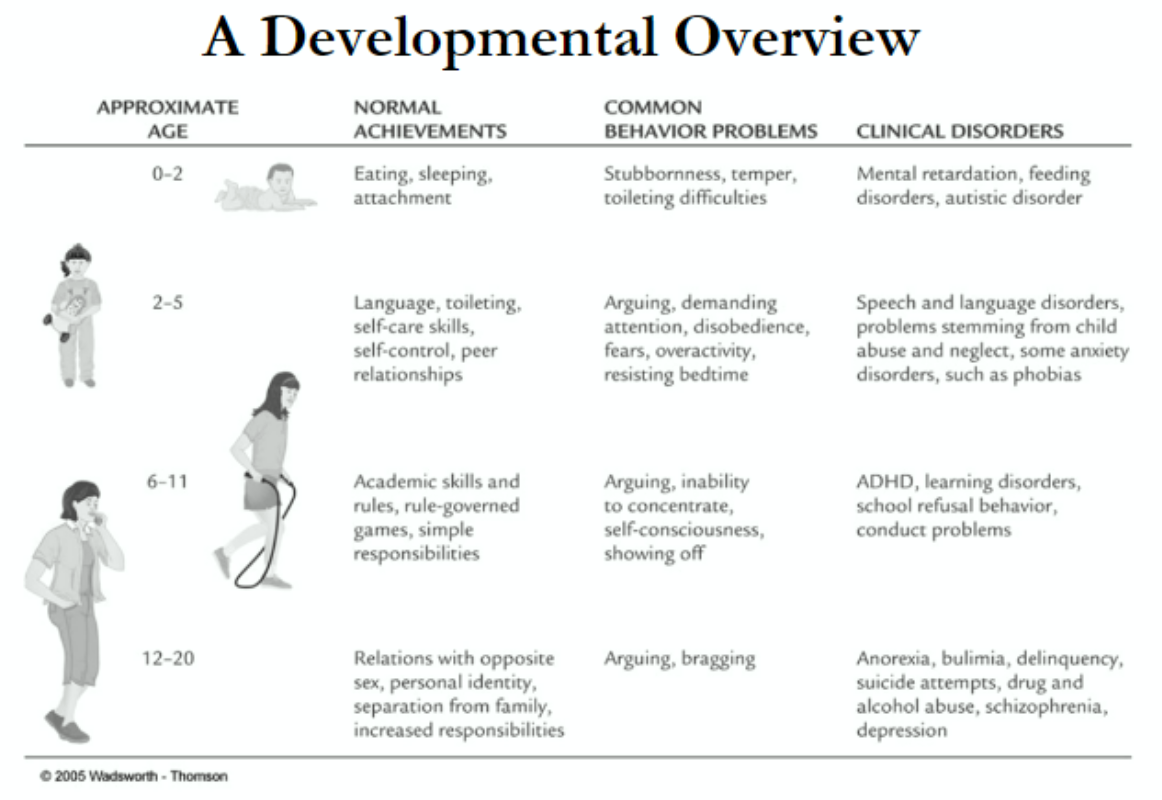
There is a strong connection between typical developmental milestones and pathologies that materialize from them.
Similarly to normal development, disorders also change with age.
- Some disorders have age specificity: for instance, feeding disorders typically only affect infants.
- Other disorders have a specific age of onset: for instance, ADHD onset usually begins in early school age.
Research on normal development informs our understanding of atypical development, and vice versa.
- Theory of mind: an individual’s ability to understand the perspectives and mentalities of other individuals
- How early do children develop this ability? Typically before the age of 6
- Force belief task: child is given a Smarties tube, but actually has pencils in it. They are asked what another child would think when first given the tube. They have developed TOM if they respond “Smarties”, since they are able to treat the other child as a separate individual who does not share the same knowledge as them.
- Example of importance: research on typical ToM provides a reference group and assessment tool for informing research on autism spectrum disorder (ASD).
- Opposite is also true: ASD research helps provides an extreme example for the role of ToM in social functioning in children, which informs typical ToM research.
- children with ASD can successfully pass ToM tasks, but struggle with transferring rules over to everyday social interaction.
Multiple Levels of Analysis #
the study of normal and atypical development must be conducted at multiple levels (illustrated below):
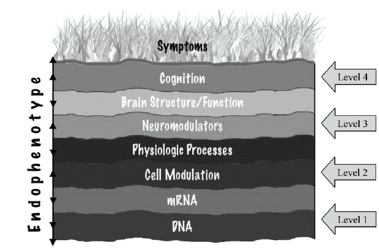
- behavioral level (what symptoms are displayed)
- cognitive level (collect metrics on cognitive processes during an experimental task)
- physiological level (use physiological metrics like stress, neuromodulator levels…)
- genetic level (study genes at the molecular level; heritability of traits)
Context is also multi-level: what exactly does “typical” vs “atypical” actually mean?
- Family situation
- Environmental context
- Bio-ecological Model of Human Development (Bronfenbrenner 1979): a child’s family, school, caretaker, and overall community environment influences development
- Includes indirect influences such as parents’ careers, school board policies, media, economy
- This is different from adult psychology; adult treatments are typically geared towards the individual
Example study: Finegood, Rarick, Blair (2017) children in disadvantaged neighborhoods had increased cortisol levels in saliva, regardless of race
- Physiological level (cortisol)
- Personal (ethnicity)
- Environment (neighborhood)
Understand risk and protective factors in development of psychopathology #
Risk Factor: An individual, family, or social characteristic that is associated with increased vulnerability to disorder
- 2 conditions: must precede AND predict a maladaptive outcome
- Example: children displaying high irritability and impulsivity have a higher likelihood of developing aggression
- Example: maternal distress during pregnancy is associated with higher likelihood of infant temperament difficulties
- Only correlated, not causal
- Possibility of comorbidity: confounding factor (example: aggression is associated with low academic achievement, but this is because aggression is related to ADHD. Aggression by itself is not a factor for academic achievement.) Asset/promotive Factor: Opposite of risk factor: precedes and predicts a positive outcome
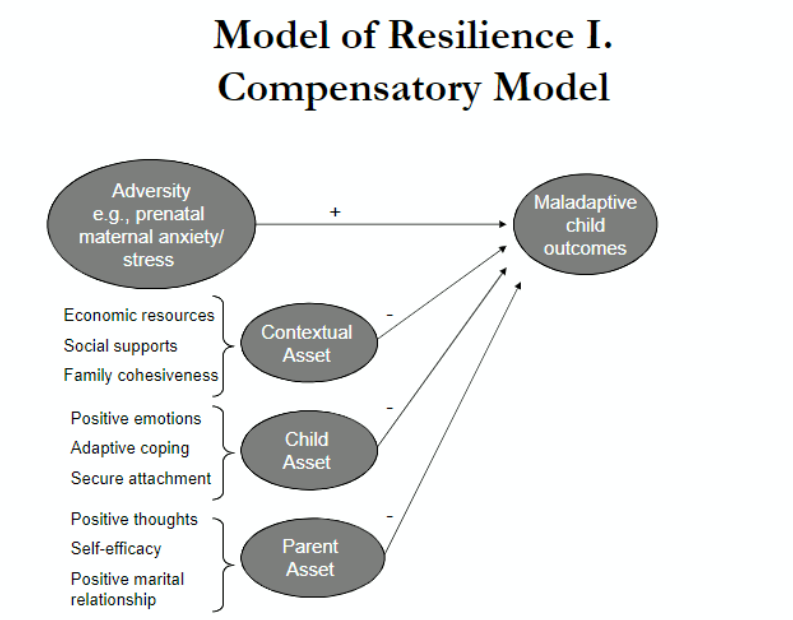
- May compensate for adverse effects of risk factors: cancels out risk factors to decrease chance of maladaptive outcome (Compensatory Model)
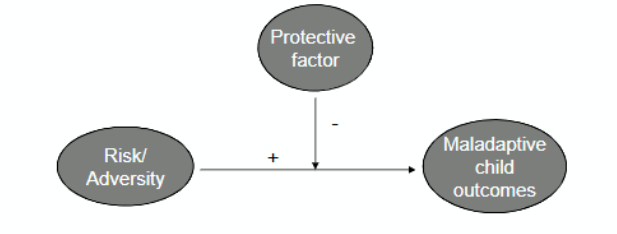
- Alternative model: Protective/Buffering Model (protective factors don’t directly result in positive outcome, but affect influence of risk/adversity based on multiple regression
 Resilience: ability for good developmental outcomes to appear in spite of serious threats to adaptation or development
 - Two criteria: individual must be exposed to threat/risk factor, AND individual exhibits positive developmental outcomes
- Two approaches for studying resilience: individuals (e.g. children with family risks such as alcoholic parents) and groups (sociodemographic risks, community violence, racial discrimination)
Investigate complex developmental pathways #
A developmental pathway is the sequence and timing of particular behaviors, risk/protective factors, and relationships between behaviors over time.
Studying developmental pathways involves:
- Understanding the sequence of risk and protective factors
- Using statistical models to correlate risk/protective factors with development of psychopathology
Two examples of developmental pathways include:
- Multifinality: similar early experiences or risk factors lead to different outcomes
- Equifinality: different early experiences or risk factors lead to the same outcome