 ben's notes
Genetics
Genotype: the physical structure of the gene
- Allele: two or more forms of a gene for a specific trait (see traits for the dominant/recessive Mendelian basics in an anthropology context)
- Polymorphism: presence of two or more variants of a sequence (important because expressions of mental disorders often come in multiple forms) Phenotype: any assessable characteristic Endophenotype: A heritable intermediate phenotype associated with a disease. Biological and behavioral markers of genetic vulnerability
Example: schizophrenia
- Genotype: gene for schizophrenia
- Phenotype: expression of the disease
- Endophenotype: abnormal eye tracking
Heritability: If a disorder has an X% heritability, X% of the variability in disorder-related symptoms within the population can be attributed to genetics. The same construct applied to personality traits is discussed in Heritability of Personality.
- Heritability estimate: $h^2 = 2(r_{mz} - r_{dz})$ where $r_{mz}$ is monozygotic twin correlation and $r_{dz}$ is dizygotic twin correlation
- ADHD, autism have high (>80%) heritability estimates
Behavioral Genetics #
Behavioral genetics studies focus on how variation in behaviors results from the combination of heritable and environmental factors.
Methods include family studies, twin studies, and adoption studies (similar genetics, different environment).
Limitations:
- heritability estimates only apply to populations, not individuals
- heritability estimates for the same behavioral trait vary considerably across study samples
- difficult to identify exact genes that cause behavioral issues
Molecular Genetics #
The field of molecular genetics focuses on identifying the specific gene polymorphisms that underlie phenotype variations.
There are two main study designs:
- linkage studies scan broad sections of the genome to identify genetic markers in known locations on the chromosome.
- association studies focus on a specific candidate allele that is suspected for conferring risk of a particular disorder.
Gene-environment correlations #
One type of association is known as gene-environment correlation (rGE), which refers to the correlation between the child’s genotype and environment.
- Passive rGE is a variation where the parent’s genotype influences both the child’s genotype and the environment. In this situation, the child has no direct association between their environment.
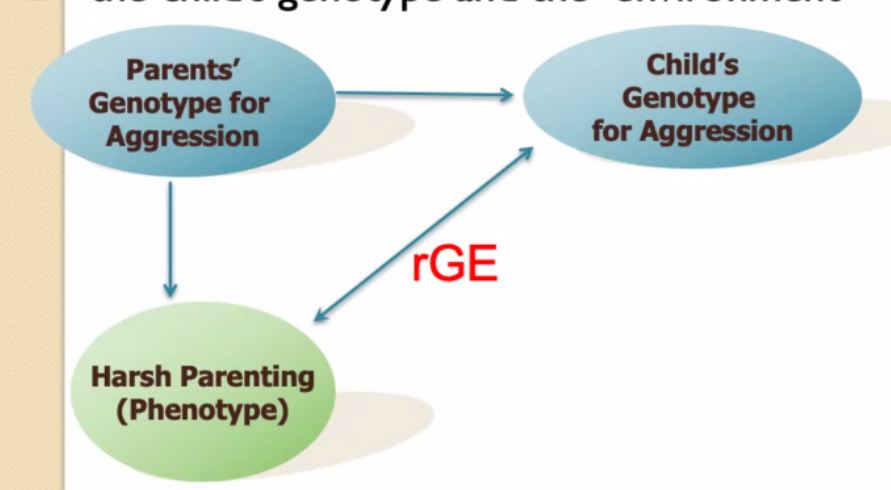
- Active rGE is when a child’s genetic dispositions directly influence the child’s selection of the environment.
- Children seek out specific situations because of their genetic predisposition. As an example, children who enjoy physical activity are more likely to play sports.
- Evocative (reactive) rGE is when genetically influenced behaviors elicit reactions from others: for instance, a child with ADHD could prompt parents to employ
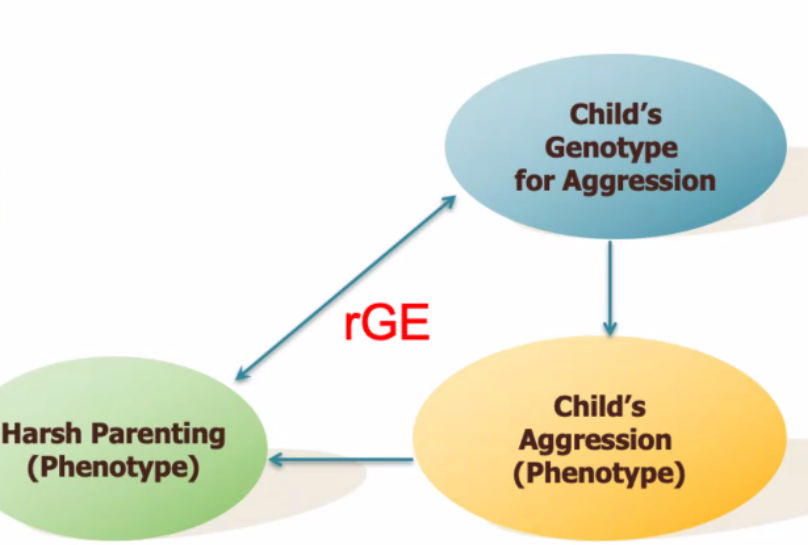
In an ADHD study: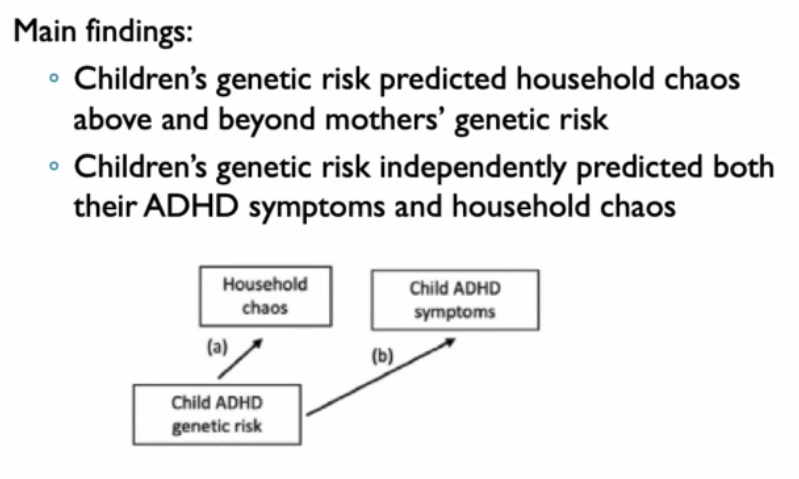
Gene-environment correlation vs gene-environment interaction #
Correlations (passive, active, evocative) refer to how genes influence exposure to certain environments.
Interactions refer to how genes influence an individual’s sensitivity to certain environments.
- Example: people with a certain gene that metabolizes pesticides have a higher susceptibility to Parkinson’s disease in environments with pesticides.