 ben's notes
Temperament
What is temperament? #
Temperament is defined as the constitutionally-based individual differences in emotional, motor, and attentional reactivity and self-regulation. See Temperament and Birth Order for the personality-psych treatment of the same construct, and Trait Theory for how temperament relates to adult personality.
- Biologically based and influenced by maturation, heredity, experience
- Consistent across situations
- Becomes more stable across time and development (adults are generally calmer than young children - rank order stability)
- Temperament as a child is related to temperament as an adult
- Related to personality
- More biologically based than personality, and detectable in early life
Temperament and behavior #
When individuals react to unfamiliar or unexpected events, two main categories of temperamental biases in infants (Kagan):
- inhibited response elicits restraint, caution, avoidance
- uninhibited response elicits spontaneous approach
Temperament and Psychopathology #
Direct relationships: extreme temperament = psychopathology Transactional relationships: temperament affects environment, which can influence other processes (similar to evocative gene-environment correlation) Indirect relationships: temperament affects psychological processes (like emotional regulation), which can develop into psychopathology
Measuring Temperament #
- questionnaire reports (parent, teacher, child)
- behavioral observations
- computerized measures
Two main approaches for studying individual differences:
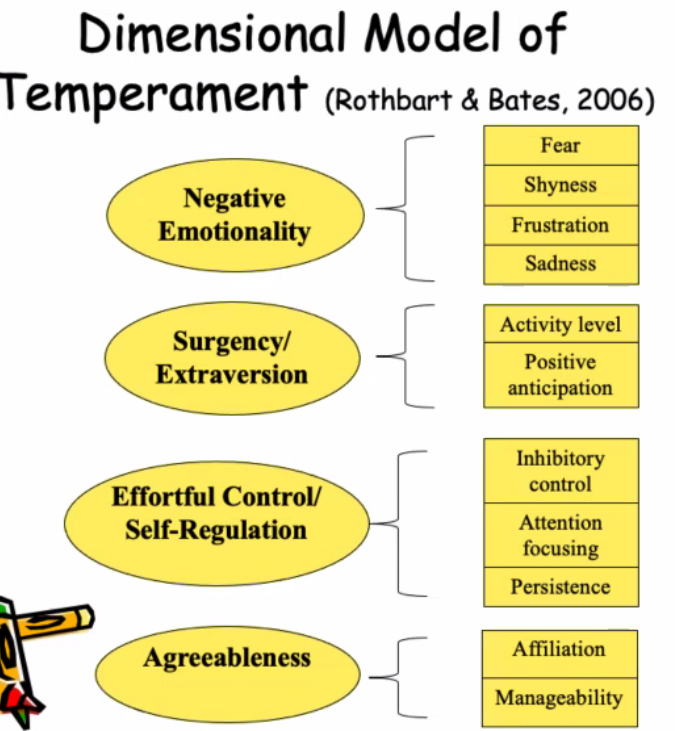
- variable-centered approach: characterize temperament on different dimensions
- person-centered approach: group children into different categories based on temperament profiles
- example: based on parent interviews, babies can be categorized as “easy”, “difficult”, “slow-to-warm-up”