 ben's notes
Introduction
Why study language development? #
Language learning is an astonishing feat of human development. By the age of 18 months, young children can already form simple sentences and communicate thought. As our language skills grow increasingly complex over age, it develops into a skill that is unique to humans and forms the foundation of modern society.
Behaviorism, Nativism, and Constructivism #
Behaviorists claim that language is learned through reinforcement: the mind is like a black box where inputs are mapped to outputs based on past experiences. Under the behaviorist approach, the only evidence used is what can be directly observed and inspected (stimulus and response).
- Evidence: Skinner’s research on conditioning/reinforcement in animals
- Tape recorder theory: children learn to store utterances in memory, and recall them in response to stimuli.
- This can be disproved by observing that responses are context-dependent: stimuli can result in many different responses, many of which are valid. Furthermore, language can’t be memorized since there are an infinite combination of words that produce valid responses, and many sentences are unique.
This contrasts with Nativists and Constructivists, who do care about the mental processes in addition to the inputs and outputs (mentalistic theories).
- Nativists: focus on a possible universal grammar, and hypothesize that language is innate knowledge that we are born with. Nativists are domain specific in which the tools we have are specifically geared for language learning.
- One key nativist hypothesis is the existence of a universal grammar that serves as a blueprint for language that we are all born with. Some evidence that supports this refers to the invariant principles shared by all languages such as the existence of nouns and verbs.
- Constructivists hypothesize that we are born with the basic mechanisms and desire to learn, since environmental influences build upon innate non-linguistic abilities. Constructivists use a domain general approach, since they believe our innate toolbox can be used for many types of learning, not just language learning.
Overall, it appears that language is a set of behaviors that is learned via reinforcement.
Rules of Grammar #
Prescriptive rules determine how we should talk formally: for example, double negatives are conventionally incorrect.
Descriptive rules determine how language is actually used, and are part of a speaker’s unconscious knowledge of language. For example, we all know the rule that the word ’the’ comes before the noun it is referring to.
These rules of grammar are not always followed: even the most proficient speakers will make occasional mistakes that do not detract from understandability.
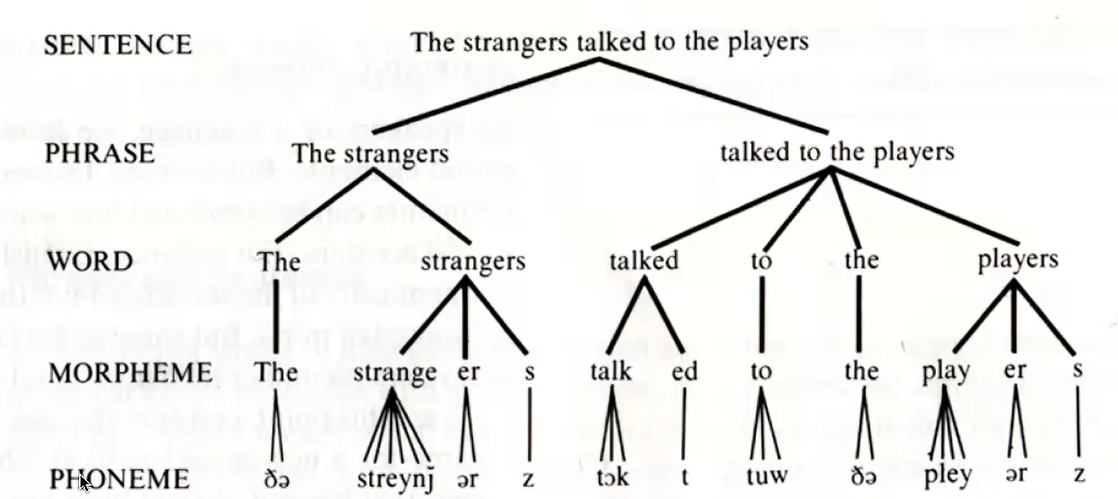 Language can be represented in a hierarchy of complexity.
Phonology #
The most simple building block of language is the phoneme, which is a category of speech sounds. Phonemes are contrastive, meaning that changing a phoneme can change the meaning of a word. Phonemes vary based on language.
Morphology #
Morphemes are the smallest meaningful units of language (that hold some sort of meaning on their own). They combine into words based on a set of combination rules. For example, the ’ed’ phoneme can be attached to the end of a verb to change its tense.
Syntax #
Words are grouped into phrases and sentences using the rules of syntax. On its own, syntax can provide context and meaning clues that can be inferred based on common patterns.
Phases of Language Learning #
Pre-linguistic communication (0-12 months) #
When we’re born, we can’t speak sentences right away. However, children can babble (make meaningless language-like sounds that combine consonants with vowels).
- Babbling is not limited to auditory modality: it has also been observed in children learning sign language.
Children also develop the ability to hold joint attention, which includes gaze-following and early forms of communication. Joint attention is part of the foundation for language learning, since it can be used to associate words with objects in the real world.
Single word speaking (12-24 months) #
Learning words begins slowly, but accelerates over time. Initially, children may make errors:
- overextension: using a specific word (like daddy) to refer to something general (like all men)
- underextension: using a general word only for a specific thing
- mismatch: using a completely incorrect word for an object
Most early words refer to concrete objects, people and animals; some will also be important social words (like hello, please, yes)
Telegraphic speech (18-30 months) #
Starting at the age of 18 months, children begin to develop the ability to put multiple words together. Grammatical words (like the, of) and inflectional morphemes (-ed, -s, -ing) are often omitted, and grammar is largely incorrect but words are placed in the correct positions and produce the desired meaning.
An example of telegraphic speech could be “I pet dog”.
Further grammatical development (2-4 years) #
By the age of 3, children begin to follow grammatical rules, and only make errors 10% of the time for known rules.
By the age of 4, grammar is almost perfect, and children obtain the knowledge of language-specific things like case marking and gender.
Scaffolding Language Learning #
Some methods parents can use to scaffold language learning include:
- feedback (positive reinforcement)
- repetition
- offering input
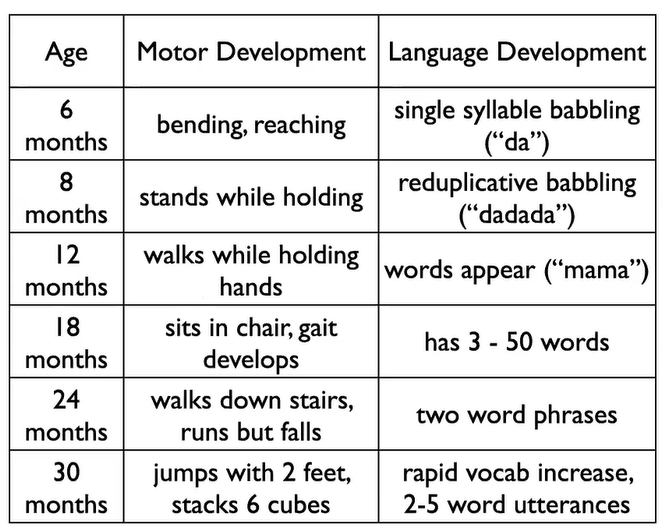 It appears that the stages of development are universal (independent of native language).
maturational hypothesis: children require exposure to language, but language development is relatively independent of the environment. Language development is expressed through the maturation of language-specific structures in the brain.
- nativist, domain-specific hypothesis
- predicts that language-acquisition mechanisms are not needed once the language is learned
Alternate hypotheses:
- language development is environment dependent, but environments worldwide follow the same stages
- Changes occur in domain-general ability, rather than domain-specific
- Poverty of the stimulus: no external stimuli are required to learn language
Child-directed speech #
In Western cultures, parents often talk to babies and young children even before they are able to understand speech. This type of speech has been hypothesized to be a necessary component of language learning, since babies overhear a lot of speech around them, but do not have a lot of speech directed toward them.
- Child-directed speech is not strictly necessary for language learning (cross-cultural comparison with Mayan culture)
- Properties of CDS:
- Fewer declarative sentences
- Large range of sentence types (questions, imperatives)
- May not follow all grammar rules (but no correlation between correctness and brevity/length and child progression)
There is a correlation between the number of words heard by children and their language learning ability / academic performance. There is also a correlation between socioeconomic status and the number of words heard. (Over the course of the month, as parents feel less financially secure, they speak less to their children.)
- This does not mean that child-directed speech is necessary: children in other cultures where CDS is not common are still able to learn languages in the same way. This suggests that children adapt their learning strategy to the environment.
Cases of atypical development #
Visual Perception (blindness) #
Although many words seem to be tied to visual perception (such as physical objects and their appearances), blind children seem to learn language similarly to sighted children, but may have different responses to the same words.
Feral Children #
Some children have been deprived of language until much later in age. Studies have shown that the extent to which they are able to develop normal language capability is dependent on age.
Spontaneous sign systems (deafness) #
Deaf children and their families often create home sign systems that are invented by the children, and reinforced by parents. Since it appears that the children are creating the systems (not the parents), this provides evidence for nativist hypotheses.
This finding has been replicated cross-culturally (Chinese families).
Children’s preferred word orders do not appear to be related to the presence of sequiturs (relevant, comprehending reactions to child’s sentence), providing more evidence for child-driven development.
Sign systems are generated at a similar pace of development, but lack the full complexity of a typical language (supports constructivism).
Pidgins and Creoles #
Historically, two different peoples speaking different languages come together, and need to develop an in-between language known as a pidgin so they can communicate at a basic level.
Eventually, some pidgins are long-lived enough that they become creoles, which have native speakers. Creoles are more complex than pidgins (stable word order, morphemes, grammatical structures).
Evidence from Bickerton suggests that creoles from unrelated languages and regions have similar grammatical structures, supporting nativist approaches to language. Furthermore, since creoles are more complex than pidgins, it suggests that children are the ones driving the development of the language.
Nicaraguan Sign Language #
NSL is a unique example of a language that has been documented at all stages of its development since its origins in the late 1970s.
At first, NSL was created spontaneously when children using different home sign systems came together and attempted to communicate. Over time, children of many different ages were introduced to the language.
Over time, the speed and complexity of signing increased, as a combinatorial system emerged in newer cohorts. In addition, children invented a sequential strategy for explaining events, which emerged independently from previous cohorts that used a simultaneous strategy.
The main finding from the research is that children are able to create discreteness and hierarchical combination in language, even when it is absent from their exposure to existing language.
Learnability Theory #
Language learning can be thought of as a case of induction: given specific instances, children learn to generalize those examples into language rules.
Formally, the child is trying to learn the target language $T$; using the environment and innate learning mechanisms, the child creates a hypothesized language $H$. Successful language acquisition occurs when $H = T$.
Children use evidence from their environment to adjust $H$:
- Positive evidence: information from the environment about what sentences are possible in the target language (overhearing examples, etc)
- Negative evidence: information about what sentences are not possible in the target language (corrections, etc)
Pinker’s superset argument: Children sometimes find themselves in a superset situation (where the hypothesis allows both correct statements and incorrect statements). Even when they don’t get negative evidence disproving the incorrect statements, they are able to avoid the incorrect statements over time.
- Not getting negative evidence happens often, since parents tend to focus on whether the statement is factually correct rather than grammatically correct, and in the process may even expand on errors
- Parents don’t respond to grammatical sentences in any statistically different ways compared to ungrammatical ones, so the signal may be too weak for children to learn from.
Nature vs nurture arguments: Based on the evidence above, we can conclude that it is necessary to have a communicative partner and some language input to learn a language, but other more complex structures (like child directed speech) are not required.
- Some unnecessary features are still helpful (at least in WEIRD studies), including:
- exaggerated intonation
- language that follows child’s attention
- larger number of more complex words directed at the child
- eliciting conversations and asking questions (call and response)
Critical Period Hypothesis #
According to the critical period hypothesis, there is a specific phase in life where humans have heightened sensitivity to environmental information needed to learn language. An example of critical periods in the wild is imprinting in animals, where babies become attached to their mothers or caretakers shortly after birth.
- Neuroplasticity hypothesis: if that part of the brain is not used for its purpose, it will be repurposed for another use.
- The critical period hypothesis suggests that there is a discontinuity between early exposure and late exposure, as learning ability sharply declines after the critical period ends. Evidence for this hypothesis is most prevalent in studies on children who were reintroduced to society later in life: specifically, late learners in ASL are unable to learn the language to the fullest extent.
Properties of Language #
To determine if language is unique to humans, we define language as having the following properties:
- Reference/arbitrariness: symbols are discrete and often arbitrary, and can stand for other things that are unrelated to the appearance or sound of the symbol
- Discreteness: language can be built from discrete units, and combining units together in a particular order creates meaning
- Productivity: an infinite number of combinations can be created; some change the language as new words and novel utterances are formed.
- Intentionality: goal of language is communication, in addition to achieving goals or behaviors
- Decontextualized: can be applied across many contexts
- Displacement: language can refer to constructs in different times and spaces
- Interchangeable: we can use new words if we hear others use them in context; common words mean the same thing to all speakers
- Generic: common nouns and verbs apply to all members of a category
- Perspectives: can refer to the same object using different words using different perspectives (chase vs flee)
- Cultural transmission: language is not fully innate, and is transferred through cultural learning from experienced speakers. Language is constantly evolving and is dependent on cultural and social factors
- Duality of patterning: small, meaningless units (phonemes) can be combined into meaningful units (morphemes)
Displacement, productivity, cultural transmission, prevarication, reflexiveness, learnability, and duality of patterning appear to be unique to humans.
The others have been shown to be shared with primate communication.