 ben's notes
Attachment
Attachment provides an internal working model (blueprint for behavior) for:
- Proper caregiving behaviors
- How we expect infants to react to caregiving
In a normal environment, infants develop primary regulatory strategies for attachment with parents. In this strategy, parents are seen as a secure base from which to explore the world. Children show proximity maintenance (defaults to staying near parents, and protesting separation)
- Secure children explore and play freely when their parent or caregiver is present. They are visibly upset when caregivers leave, and are happy when they return.
Functions of the attachment system:
- Proximity maintenance (staying nearby and protesting separation)
- Safe haven (turning to caregiver for comfort)
- Secure base (ability to explore outside world from safe location)
Stages of separation:
- Protest (active resistance)
- Despair (passive, sad)
- Detachment (defensive disregard for caregiver upon return)
In environments where developing this is not possible, children may develop secondary regulatory strategies such as avoidance or anxiety.
- Avoidant children avoid or ignore caregivers when they are present, and show little emotion upon return.
- Anxious/ambivalent children show distress before separation, and are difficult to comfort when caregivers return. They show signs of resentment when caregivers leave.
Johnson et al. 2010- Working Models in Infants
- Variations in attachment experience between the caregiver and infant result in different internal working models, which create different reactions of responsiveness of caregivers. Children with secure attachment should respond differently compared to children with insecure attachment.
- Test condition: children are shown videos where some caregivers are responsive (if the infant cries, the caregiver will respond), and some are unresponsive (if the infant cries, the caregiver walks away).
- Result: secure children looked at the unresponsive caregiver for longer, suggesting that this behavior differs from their internal working model. Insecure children had the opposite (looked at the responsive caregiver for longer).
Strange Situation #
The Strange Situation is a paradigm to assess attachment style in infants.
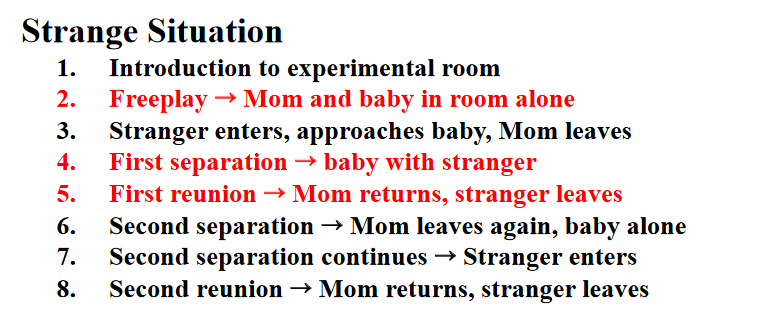
Findings:
- Secure children (60%):
- Established secure base (freely play, explore, approach strangers in caretaker’s presence)
- Proximity seeking (distressed by separation events)
- Safe haven: actively seeks contact and interaction on reunion
- Avoidant (25%):
- Independent exploration
- No proximity seeking on separation (no distress)
- No safe haven (active avoidance of caretaker during reunion)
- Anxious-Ambivalent (15%):
- Poverty of exploration: wary of new situations, stays with caregiver instead of exploring
- Proximity seeking activated by separation
- Ambivalent about safe haven: difficult to soothe, but both seeks and resists contact
- Does not explore after reunion
Adult Attachment #
Unlike the categorical measurements of attachment for infants, adult attachment is measured by two orthogonal dimensions:
- Anxiety about rejection: worry about being abandoned
- Avoidance of intimacy: level of comfort with closeness
Adults with anxiety and avoidant attachment have higher neuroticism, and lower values for the other facets of the Big Five. (Anxiety attachment is most strongly correlated to high neuroticism.)
- Anxiety -> N+, C-, A-
- Avoidance -> E-, C-, A-
Avoidant attachment produced a galvanic skin reaction to interviews about relationship experiences; this suggests that avoidance is a coping mechanism for negative arousal associated with relationships.
Attachment styles predict relationship quality much more strongly compared to the standard Big Five, suggesting that they cannot be represented only as a combination of personality factors.