 ben's notes
Outcomes and Applications
Outcomes #
Mortality #
- Establish relationship between personality, activity levels, and mortality in old age
- IV: extraversion, neuroticism –> DV: mortality
- Mediators: health, activity (cognitive, social, physical)
- Findings: higher neuroticism and lower extraversion were associated with higher levels of mortality (21%)
- This was because neurotic, introverted individuals had a lower level of social/physical/cognitive ability
Friedman et al. 1995- Terman Life-Cycle study, conducted from 1921 to 1986 on children with high IQ
- Gender is the best predictor of mortality: females live on average 10 years longer than males
- High conscientiousness is strongly correlated with decreased mortality
- Mediated through lower rates of disease, lower stress reactivity, lower engagement in poor health behaviors
Delinquency #
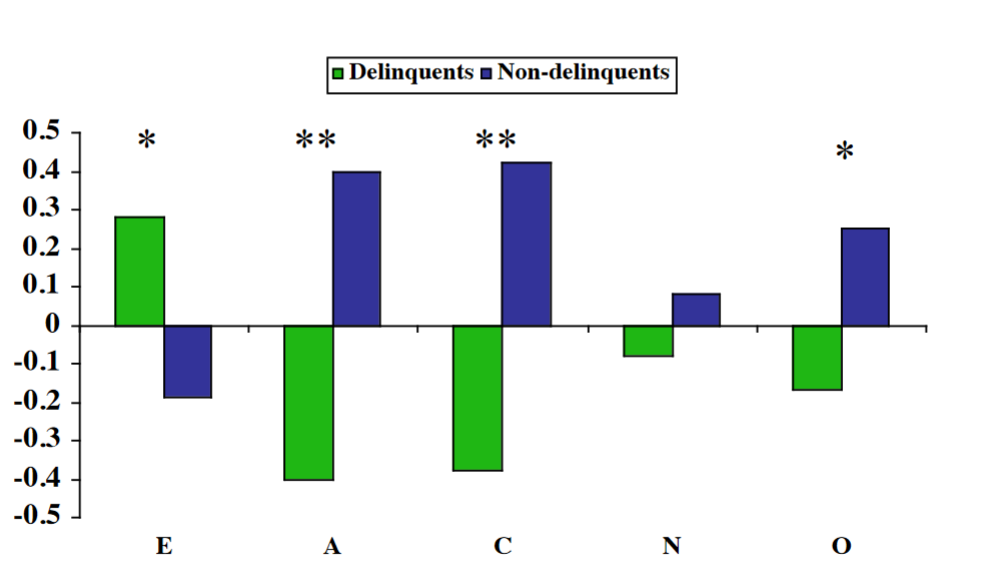
John et al. 1994
- Relationship between personality and delinquency
- Delinquents tend to have higher E, and lower A, C, O
- Low A, Low C, High E, High N = related to psychopathic personality and adult criminality (Beaver et al. 2015; O’Riordan, O’Connell 2014)
Academic achievement #
High C
- hard working, task focused
High O
- enjoy learning, curious
Leadership #
At a first glance, most people perceive that extraverts are highly competent leaders due to their assertiveness, while neurotic individuals are poor leaders since they are withdrawn and unlikely to contribute.
However, the opposite has been found- extraverts are less likely to be flexible with other group members, while neurotic individuals spend more time working on the task, thus creating a greater influence on the group.
Overall, the finding is that high extraversion is related to status loss over time, mediated by a smaller group contribution than expected.
Applications #
Myers Briggs Type Inventory #
MBTI is not based on any formal research and is not part of the standard literature. This is because it has several issues:
- Assumes bimodal distribution of the opposite poles (e.g. E vs I), but data shows a unimodal/standard distribution. This results in similar/average people right on the dividing line appearing to be different.
- Treats continuous distribution as categorical: draws arbitrary/artificial distinctions
- Lacks test-retest reliability: 50% of people get a different result taking the test 5 weeks apart
- Not valid when compared with BFI (misses important aspects of personality such as N)
- General, vague statements that cannot be falsified (Barnum statements)
- No useful real-world predictions
Despite its issues, MBTI is still popular because:
- It has positive, upbeat messages
- Creates the illusion of revealing hidden insights about personality (conflate difficulty in making ambiguous, non-opposite choices with validity)
- Part of popular culture