 ben's notes
Trait Theory
Using the psycholexical (trait) approach, researchers study the personality characteristics important in a culture by studying the lexicon for personality traits.
Traits, States, Activities #
A trait is consistent across time and situations, and has internal causes.
A state is a transitory, externally caused emotion (angry because… happy when at… surprised by…)
An activity is inconsistent and transitory, referring to what a person is doing at a given time.
The Lexical Trait Approach #
Factor analysis is a statistical method that identifies clusters of correlated traits. This was pioneered by Raymond Cattel in the mid-1900s, where he found 16 main personality factors. However, this finding was not able to be replicated.
The Big 5 Theory of Personality #
The Big 5 Theory is one of the most robust theories in personality psychology. It suggests that there are 5 main personality traits:
Openness (originality, open-mindedness) Conscientiousness (control, constraint) Extraversion (energy, enthusiasm) Agreeableness (altruism, affection) Neuroticism (negative affectivity, nervousness)
These 5 traits are the broadest of all traits, and are visible in many animals. They suggest a hierarchical structure of traits, where more specific traits are grouped together under a larger category.
Facets of Openness #
- Fantasy: active imagination
- Aesthetics: seek artistic environments/stimuli
- Feelings: strong emotions
- Actions: seek out opportunities to try new things
- Intellect: enjoy playing with theories and abstract ideas
- Values: diversity, liberalism
Facets of Conscientiousness #
- Self-discipline: ability to do tasks that are difficult but helpful in the long-term
- Dutifulness:
- Competence:
- Order
- Deliberation
- Achievement striving:
Facets of Extraversion #
- Warmth/friendliness: outgoing, willing to engage with others
- Gregariousness: enjoy parties/large groups of people
- Assertiveness: leadership
- Activity: enjoy doing lots of things
- Excitement seeking: thrills
- Positive emotions: high energy
Facets of Agreeableness #
- Trust: believe others are well intentioned
- Sincerity: honest and averse to deception
- Altruism: charitable
- Compliance: cooperative, rather than competitive
- Modesty:
- Sympathy
Moral principles: compassion -> egalitarianism, politeness -> traditionalism
Facets of Neuroticism #
- Anxiety
- Angry hostility
- Depression
- Self-consciousness
- Impulsiveness
- Vulnerability
Development and Change in Traits #
2a. Srivastava_etal_2003.pdf: There are two main hypotheses about changes in personality.
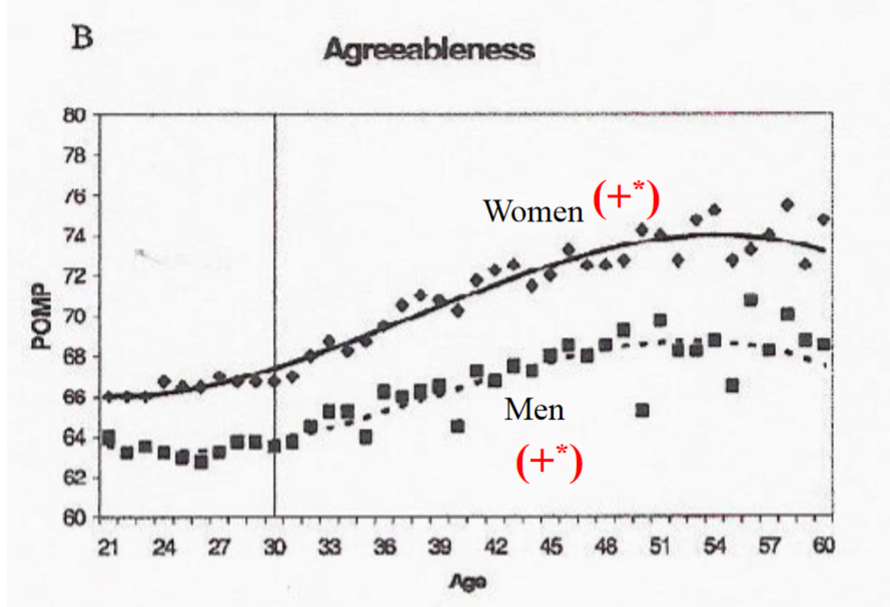
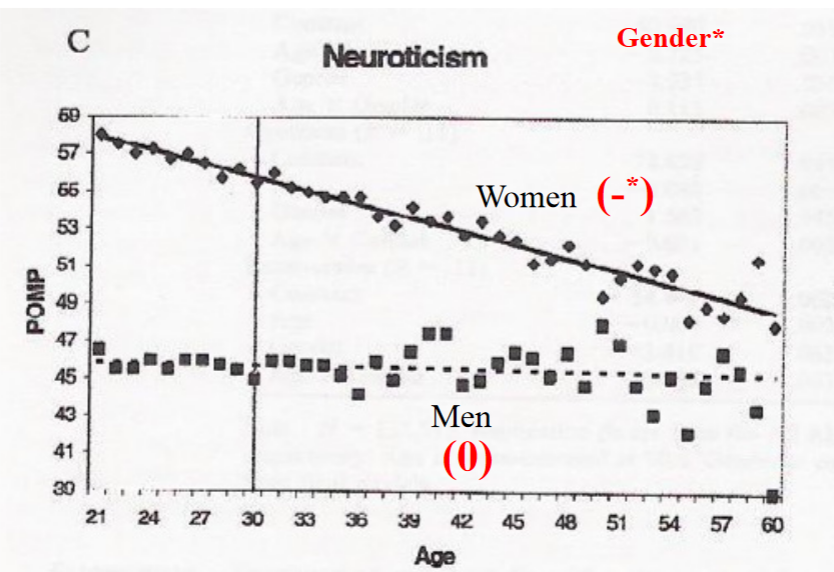
- Tested hypothesis: age (IV) affects personality, as measured by the Big Five Inventory (DV) moderated by gender
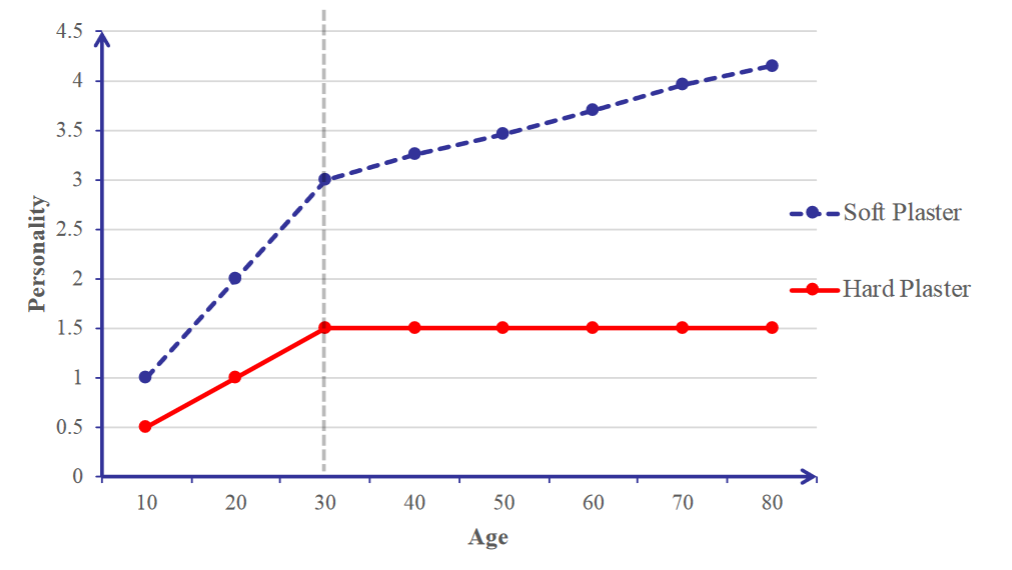
- Biologically oriented theories: personality matures by adulthood (age 30), and is relatively stable afterward.
- Hard plaster hypothesis: change seen before 30, no significant change after 30
- Contextualist theories: personality changes throughout the lifespan based on life events, social roles, gender roles, and experiences
- Soft plaster hypothesis: change still occurs after 30, but more slowly
- Findings:
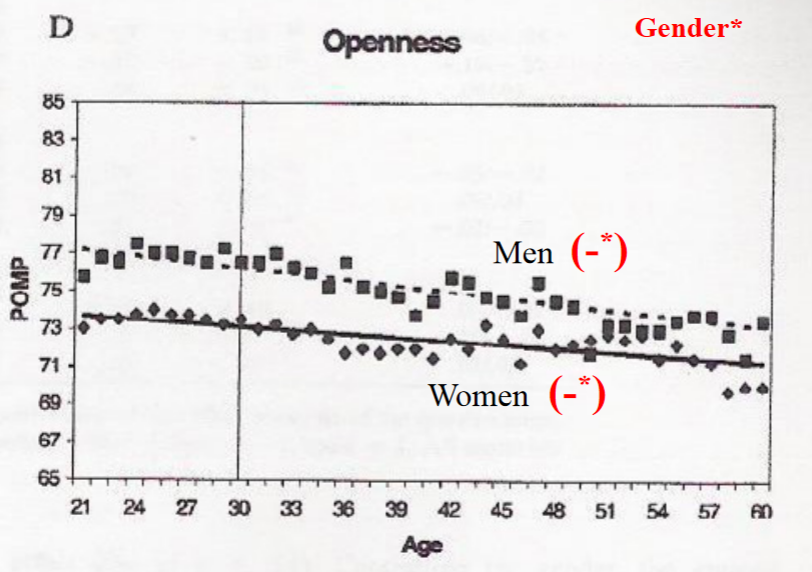
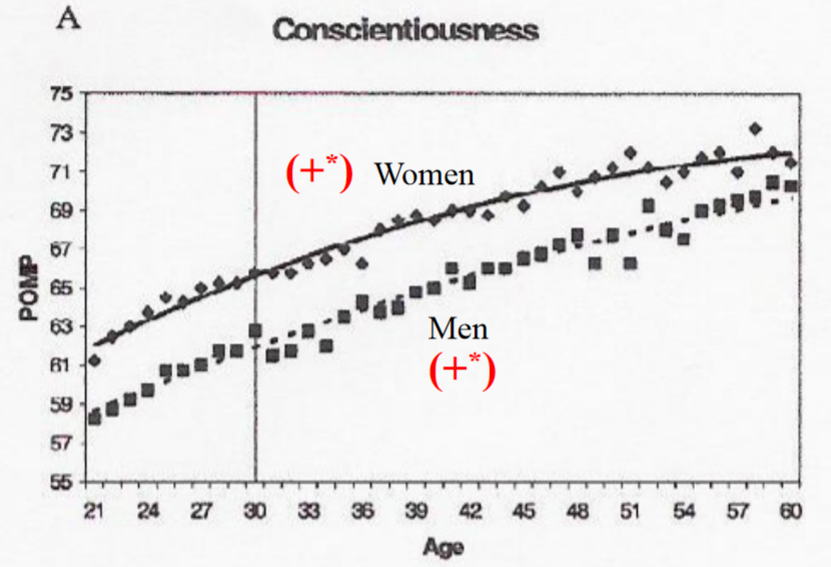
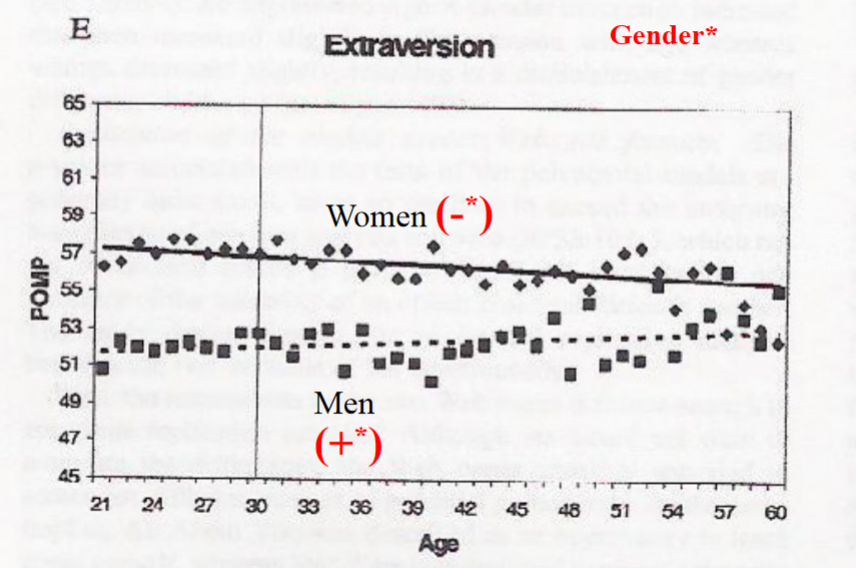
- Gender differences are related to personality differences and changes over time due to differing social environments
- Openness: slow decrease over time
- Conscientiousness: soft plaster hypothesis supported
- Extraversion: soft plaster hypothesis in men, but not women (no difference)
- Agreeableness: both plaster hypotheses rejected for men and women
- Neuroticism appears to steadily decrease over age for women, while remaining constant over time for men
- Overall, there is inconsistent support for the plaster hypotheses. A better hypothesis might be that personality continues to change throughout the lifespan, with different dimensions changing differently among different groups.
- Critiques:
- Since this is a cross-sectional design (not a longitudinal study), we can’t be certain that the change over time is really due to age, and not other cultural factors that affect people from older generations differently. For example, those born in the 1950’s might be less neurotic due to growing up in a relative time of peace.
Socioemotional Selectivity Theory (SST) #
Main idea: Time horizons grow shorter with age (we believe we have less time remaining in life)
- Changes in goals: younger individuals prioritize knowledge acquisition and exploration; older individuals focus on close relationships and social networks
- Higher incentive to regulate emotions over age to reflect this change in goals
- Increase in positive/complex emotions and ability to experience/remember positive experiences; decrease in negative emotions
- When time horizon was expanded in an experiment (participants told to imagine they had 20 more years to live), age differences disappeared
- Evidence supports the hypothesis that increased life satisfaction and positive emotion predict survivability.
Facets over age:
- Openness should decrease since actions facet decreases
- Agreeableness should increase since people have more positive emotions
- Neuroticism should decrease due to decrease in negative emotions: we shift our goals to face fewer difficult situations
- Extraversion should increase due to increased value in relationships